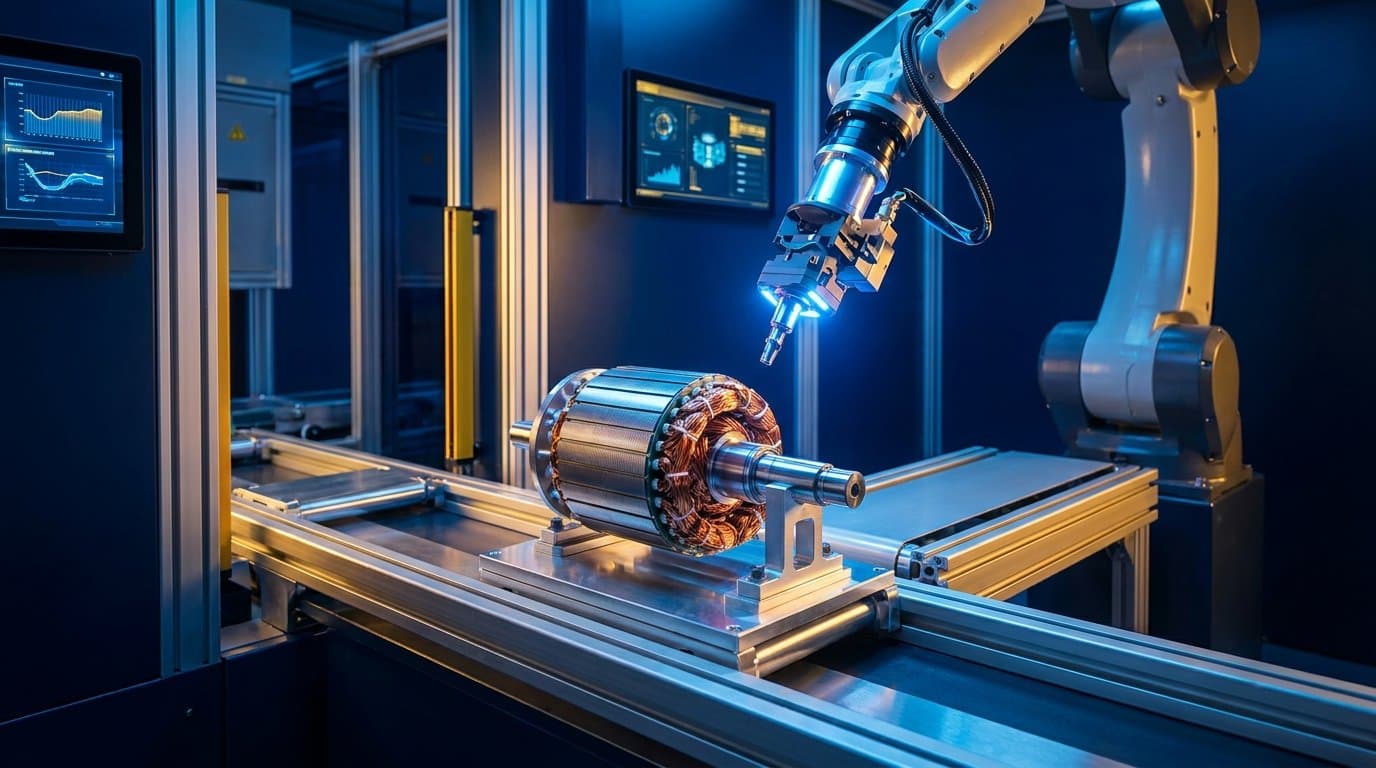
Strip an electric vehicle to its essentials and you find two mineral stories. The battery story - lithium, nickel, cobalt, graphite - gets the headlines. The motor story is smaller by mass, bigger by leverage: a kilogram or two of rare earth elements without which the modern EV drivetrain, as actually built, does not exist.
Here is the complete picture of rare earths in electric vehicles - the elements, the quantities, the substitution debate and the supply questions every automaker is now forced to answer.
The Motor Is the Rare Earth Story
Most EVs on the road use permanent magnet synchronous motors (PMSMs) - around four in five globally. Their rotors carry NdFeB magnets (neodymium-iron-boron, detailed in our magnets guide), and those magnets are why PMSMs win:
- Highest efficiency across real driving cycles - the rotor's field is free, not generated by current
- Power density - smaller, lighter motors for the same output, liberating packaging and range
- Low-speed torque - the responsive character buyers associate with EVs
The rare earth recipe inside a traction magnet:
- Neodymium + praseodymium (NdPr) - the magnetic backbone, ~29–31% of magnet mass (our NdPr guide covers why these two elements dominate the industry's economics)
- Dysprosium and/or terbium - grain-boundary additions that keep magnets stable at rotor temperatures of 150–180°C; without them, hard acceleration on a summer highway becomes a demagnetization event
- Beyond the traction motor: dozens of NdFeB micro-motors (windows, seats, pumps, steering assist), speakers and sensors add grams apiece
How Much Rare Earth per Vehicle?
Representative figures across the fleet:
| Vehicle type | NdFeB magnet mass | Contained rare earths |
|---|---|---|
| Battery EV (PM motor) | 1–2.5 kg | ~0.3–0.8 kg NdPr, 10–100 g Dy/Tb |
| Plug-in / full hybrid | 0.5–1.5 kg | proportionate |
| Conventional car (accessories) | 0.2–0.5 kg | grams-scale |
Multiply by a market heading past 40 million plug-in vehicles annually in the early 2030s and the arithmetic is stark: EVs are the single largest growth driver for NdPr and the heavy rare earths, with magnet demand forecast to grow 7–9% per year through 2035.
Can Automakers Design Rare Earths Out?
The substitution question gets asked after every price spike and export-control episode. The honest answer: partially, at a cost, and slowly.
The alternatives on the table:
- Induction motors - no magnets (Tesla's original choice). Penalty: lower efficiency at cruise, more mass; many OEMs now pair one induction unit with a PM motor in dual-motor cars - reducing, not eliminating, rare earth content
- Externally excited synchronous motors (EESM) - copper-wound rotors replacing magnets (BMW, Renault, some ZF designs). Penalty: rotor excitation losses, slip rings or wireless excitation complexity, more copper
- Ferrite or Dy-free magnet designs - clever geometries stretch weaker or leaner materials; grain-boundary diffusion has already cut Dy loadings dramatically
- SmFeN and other emerging chemistries - promising for auxiliary motors, unproven at traction scale
The realistic outlook: engineering ingenuity keeps shaving intensity per vehicle - thrifted Dy, some magnet-free models - while fleet growth overwhelms the shavings. Every credible forecast has absolute rare earth demand from EVs rising steeply through the 2030s. Substitution disciplines prices; it does not repeal them.
2025–2026: When Risk Became Operational
The theoretical vulnerability turned concrete: China's export controls on rare earths and magnets from April 2025 disrupted automaker supply chains within weeks - production adjustments, emergency airfreight, board-level task forces. With China refining ~92% of NdPr and ~99% of Dy/Tb (how that happened), and magnet manufacturing similarly concentrated, the EV industry discovered its motors had a single point of failure.
The response is reshaping procurement:
- OEMs contracting upstream - direct offtakes with miners, separators and magnet plants (GM–MP Materials being the template), sometimes with prepayments
- Western capacity building - magnet plants in the US and Europe ramping under defense-anchored price floors
- Dual-sourcing mandates - motor platforms engineered to accept magnets from multiple qualified suppliers
- Recycling programs - motor-to-motor loops in pilot; meaningful volume only in the 2030s (see recycling's real timeline)
What It Means Down the Supply Chain
For everyone feeding the EV motor chain - separators, magnet makers, traders - the implications are concrete:
- NdPr units are the product. Whatever the feedstock, buyers price the contained neodymium-praseodymium; concentrate with documented NdPr distribution (per lot-specific COA) is what the new Western plants are contracting for
- Dy/Tb access is the differentiator. High-temperature automotive grades need heavies; supply outside China is thin and premium-priced (heavy vs light explained)
- Origin documentation is a qualification requirement. Automotive OEM flow-downs increasingly demand chain-of-custody evidence - CRMA-era procurement extends from cathodes to magnets
- Timing favors the early. Motor programs qualify materials years ahead of production; feedstock contracted in 2026 supplies the model year 2029 ramp
The Qualification Timeline: Why 2026 Feedstock Decides 2029 Cars
Automotive procurement runs on timelines outsiders consistently underestimate. A motor entering production in model year 2029 froze its magnet specification in 2026–2027; the magnets' supplier qualified their materials 12–18 months before that; and the separator feeding that magnet plant contracted concentrate earlier still. The chain of lead times means today's feedstock decisions are already embedded in vehicles that won't reach showrooms for three years - and explains why separators and magnet makers sign multi-year concentrate agreements while spot buyers wonder what the hurry is.
The 2025 export-control shock compressed sympathy for the unprepared: OEMs that had qualified single-source Chinese magnet supply faced line-stoppage risk within weeks, while those with dual-sourced, dual-origin magnet strategies rode through on inventory and alternates. The procurement lesson institutionalizing across the industry: treat magnet materials like semiconductors - strategic components with qualified alternates, buffer stock and upstream visibility, not commodity line items.
Frequently Asked Questions About Rare Earths in EVs
Do all electric vehicles use rare earth magnets? Around four in five globally use permanent-magnet motors. The exceptions - induction machines (some Tesla units, notably) and externally excited synchronous motors (BMW's fifth-generation drives, several European platforms) - trade rare earth exposure for efficiency, mass or cost penalties, and several appear in dual-motor configurations alongside a PM unit anyway.
How much does the rare earth content add to an EV's cost? At typical NdPr prices, the traction magnet's rare earth content runs low hundreds of dollars per vehicle - trivial against battery costs, which is precisely why substitution pressure stays muted until supply availability, not price, is threatened.
Are hybrid vehicles lighter users of rare earths? Per vehicle, moderately - smaller motors mean less magnet mass (0.5–1.5 kg versus 1–2.5 kg). Fleet-wide, hybrids' higher volumes make them enormous aggregate consumers; Japan's hybrid-heavy industry was among the loudest casualties of the 2025–2026 supply cutoffs.
What happens to EV motor magnets at end of life? Today, mostly nothing - vehicles retire into shredder streams where magnet material disperses. Motor-to-motor recycling pilots and design-for-disassembly programs aim to change that before the 2030s retirement wave; the recovered NdFeB from EV fleets will eventually be the richest recycling stream on earth.
How can motor-chain suppliers secure rare earth exposure now? The pattern the leaders set: multi-year formula contracts for concentrate or oxides, dual-origin qualification (Chinese plus documented ex-China), buffer inventories sized to qualification lead times, and upstream relationships established before crises - the full playbook our buying and sourcing guides detail.
Key Takeaways on Rare Earths in EVs
- 1–2.5 kg of NdFeB per EV traction motor - modest per vehicle, decisive at fleet scale: EVs are the largest single driver of NdPr and heavy rare earth demand growth.
- Four in five EVs use permanent magnet motors because efficiency equals range; induction and EESM alternatives exist as hedges, mostly alongside PM units rather than instead of them.
- Dysprosium is non-negotiable at operating temperature: hot rotors demand heavy rare earth additions - EV growth is heavy rare earth growth, the market's tightest corner.
- Substitution shaves, fleet growth swamps: thrifting and magnet-free designs discipline intensity per vehicle while absolute demand compounds through 2035 on every credible forecast.
- 2025 made risk operational: export controls reached automaker production lines within weeks, converting magnet materials from line items into semiconductor-style strategic components with dual-sourcing mandates.
- Qualification lead times govern: 2026 feedstock decisions are embedded in model-year 2029 vehicles - the procurement clock runs years ahead of the showroom.
- The upstream response is contractual: OEM offtakes reaching to separators and miners, buffer inventories and origin-documented supply - the playbook now defining motor-chain procurement.
Feedstock for the EV Decade
CriticalOre supplies the raw material at the start of the chain: rare earth concentrate, monazite and bastnaesite from Southeast Asian origins, independently assayed with full NdPr and heavy element distributions, documented for compliance-grade procurement.
If your business touches the EV motor chain - processing, magnets, trading or OEM supply strategy - request a quote and secure the units the whole industry is chasing.