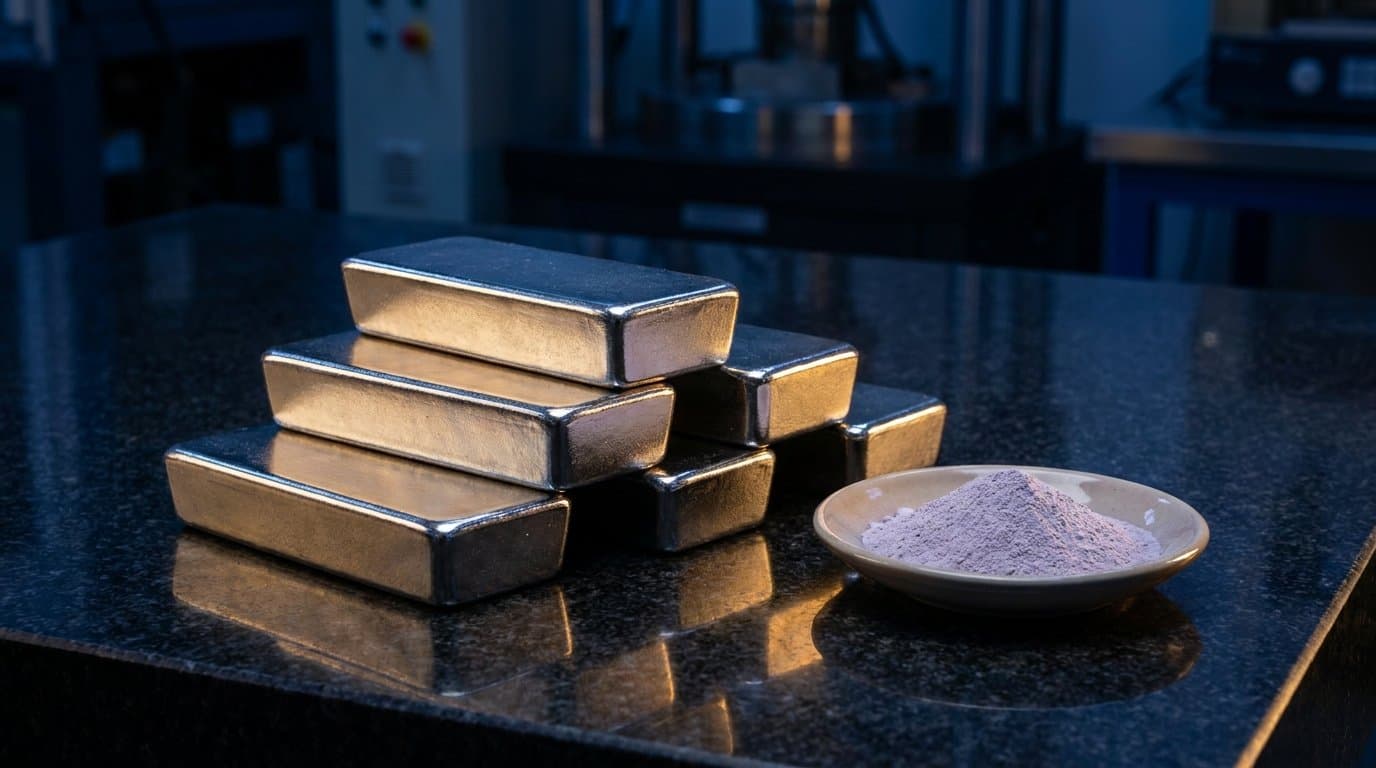
Strip away the complexity of seventeen elements, four mineral families and a dozen end-markets, and the rare earth industry largely reduces to two letters: NdPr. Neodymium and praseodymium - almost always discussed, priced and traded together - account for well over half of the entire rare earth market's value despite representing a modest fraction of its tonnage.
Understanding NdPr is understanding the rare earth business. Here's the complete picture.
What Is NdPr?
Neodymium (Nd) and praseodymium (Pr) are neighboring light rare earth elements, atomic numbers 60 and 59. They occur together in every commercial rare earth mineral, behave almost identically in chemistry, and serve the same dominant application - so the industry treats them as a pair.
They are traded in several forms:
- NdPr oxide - the mixed oxide, the most commonly quoted benchmark product (typically 75% Nd / 25% Pr)
- NdPr metal (alloy) - the reduced metallic form used directly in magnet alloy production
- Separated neodymium oxide / praseodymium oxide - for applications requiring individual elements
- Contained NdPr in concentrate - what buyers of rare earth concentrate are really paying for
Why NdPr Commands the Market
One application towers over everything: NdFeB permanent magnets - neodymium-iron-boron, the strongest commercial magnets ever produced.
A NdFeB magnet delivers extraordinary magnetic force per gram, which makes it irreplaceable wherever power density, efficiency and miniaturization matter:
- Electric vehicle traction motors - 1–2 kg of NdFeB per vehicle; the majority of EVs use permanent magnet motors
- Wind turbines - direct-drive designs use several hundred kilograms of magnet per megawatt
- Consumer electronics - smartphone haptics, speakers, hard drives
- Industrial automation and robotics - servo motors in every axis
- Defense - precision-guided munitions, aircraft actuators, submarine propulsion
- Data centers and AI infrastructure - cooling systems and drives feeding unprecedented demand growth
Roughly 30% of rare earth volume goes into magnets - but that volume carries around 80% of total market value. Within magnet demand, NdPr is the indispensable core; dysprosium and terbium are added in smaller amounts for high-temperature performance.
Supply: A Chinese Story With New Chapters
NdPr supply concentration is the strategic vulnerability that keeps Western procurement officers awake:
- China controls approximately 92% of refined NdPr production
- Chinese firms also dominate magnet manufacturing itself (~90%+ of NdFeB output)
- Export controls introduced from April 2025 onward turned this dominance into active leverage, with licensing requirements restricting flows to defense-linked users and entire countries at various points
The response outside China has been the largest wave of rare earth investment in history: MP Materials' mine-to-magnet buildout in the US (backed by Department of Defense price floors), Lynas expanding in Australia, Malaysia and Texas, new separation plants announced in Europe and Southeast Asia, and government stockpiling programs across the G7.
Still, combined Western NdPr output covers less than 15% of global demand - a gap that will take most of a decade to close. Meanwhile, ex-China material trades at persistent premiums.
How NdPr Is Priced
There is no NdPr futures market of consequence for physical trade. Prices come from assessment agencies - Fastmarkets, Asian Metal, Argus, SMM - which survey actual transactions and publish reference prices for NdPr oxide and metal, in both Chinese domestic and ex-works/export terms.
Key dynamics a buyer should understand:
- The China/ex-China spread. Since export controls began, identical material outside China has commanded premiums - modest for NdPr (versus 4–6x for heavy rare earths), but real and persistent.
- Policy floors. The US DoD's price-floor arrangement with MP Materials effectively established a Western reference level, pulling market prices toward it.
- Quota cycles. China's twice-yearly mining and separation quotas move sentiment sharply - a delayed quota announcement in mid-2026 helped fuel the July rally that saw NdPr alloy gain over 21% in a single month.
- Demand seasonality. Magnet makers stock ahead of Q4 production peaks; summer often brings softness.
For concentrate buyers, contract formulas typically reference a published NdPr oxide assessment, apply the lot's assayed NdPr content, then apply payables - as detailed in our pricing guide.
The Demand Outlook
Every credible forecast points the same direction:
- EV production continues compounding; even hybrid drivetrains use NdFeB motors
- Wind installations grow under energy-transition policy across every major economy
- Robotics and automation - humanoid robotics alone could add tens of thousands of tonnes of annual magnet demand by the 2030s
- Defense rearmament in Europe and Asia adds a price-insensitive demand layer
Adamas Intelligence and other analysts project NdFeB demand growing 7–9% annually through 2035, with supply deficits persisting despite new projects - because mines take a decade and separation plants half that.
For buyers, the strategic conclusion is uncomfortable but clear: NdPr access is becoming a competitive differentiator, and waiting for the market to normalize is a bet against every current trend.
What This Means for Concentrate Buyers
When you evaluate any rare earth concentrate offer, NdPr content is the number that matters:
- A concentrate at 60% REO with 18% NdPr share contains ~10.8% NdPr - that fraction typically carries 60–80% of the lot's value
- Cerium and lanthanum, however abundant in the assay, contribute single-digit percentages of value
- Verify NdPr by independent ICP analysis on every lot; a two-point swing in NdPr share moves real money
At CriticalOre, every quote we issue itemizes the assayed element distribution so you can value the basket transparently against published assessments.
NdPr Contract Structures: How the Units Actually Trade
Physical NdPr changes hands through a small repertoire of contract architectures worth knowing before negotiation. Spot parcels - single shipments at fixed price, referencing current assessments; flexible, but exposed to exactly the volatility July 2026 demonstrated. Quotational-period formulas - the professional standard: price set as the average of a named assessment (Fastmarkets NdPr oxide, say) over an agreed window (month of shipment, month after), with the physical premium or discount fixed in advance; both sides surf the same published curve. Collared formulas - floors and caps bounding the reference price, splitting tail risk when neither side wants naked exposure to policy shocks. Fixed-price strips with reopeners - multi-quarter certainty punctuated by renegotiation windows, favored where financing requires predictable costs. And at the strategic end, prepayment and streaming structures - buyers financing suppliers against future delivery, the model reaching upstream from OEMs as supply security becomes balance-sheet strategy.
For concentrate rather than oxide, every structure applies through the basket-and-payables translation: the reference is still the NdPr assessment; the negotiation compresses into payable percentages and element credits.
Frequently Asked Questions About NdPr
Is neodymium ever traded separately from praseodymium? Yes - separated Nd and Pr oxides trade for applications needing individual elements, at premiums over the mixed product reflecting extra separation stages. The 3:1 natural ratio and magnet-recipe interchangeability keep the mixed NdPr market dominant.
What purity grades matter for NdPr oxide? Standard commercial oxide runs ≥99% TREO with NdPr ≥75%; magnet-chain buyers specify impurity ceilings (particularly other rare earths, calcium, iron) per their alloying process. Concentrate buyers care about the distribution instead - purity is the separator's product.
How volatile is NdPr compared with other commodities? Materially more than base metals: policy events routinely move it double-digit percentages within weeks (July 2026: +21% in a month), and the 2021–2026 range spans multiples. Formula contracting and diversified origin exist precisely to make that volatility survivable.
Does the US DoD price floor apply outside America? Legally it guarantees one producer's economics; commercially it anchors everyone's expectations - a visible bid under Western supply that reshaped how ex-China material worldwide is priced and financed. Markets need reference points, and the floor became one.
What share of concentrate value does NdPr represent? In typical monazite or bastnaesite baskets, 60–85% of contained value despite under a fifth of the mass - the arithmetic that should focus every assay review, contract negotiation and supplier conversation on the NdPr lines first.
Key Takeaways on NdPr
- Two elements carry the market: NdPr's magnet role generates the majority of all rare earth value - the lines to read first on every assay, offer and news story.
- Demand is magnet demand: EV motors, wind generators, robotics and electronics compound NdFeB consumption 7–9% annually with no substitute at the performance frontier.
- Supply concentration persists: ~92% of refined NdPr is Chinese; Western capacity under DoD floors and CRMA momentum ramps through the late 2020s - with feedstock the universal constraint.
- Pricing is assessment-based: Fastmarkets, Asian Metal and peers anchor formula contracts; the China/ex-China spread and the ~$110/kg US floor are the era's structural features.
- Contract architecture manages the volatility: quotational periods, collars and reopeners - the repertoire that made July 2026's +21% month survivable for formula buyers.
- In concentrate, NdPr share is value: 60–85% of basket worth from under a fifth of mass - two assay points of NdPr swing more money than ten points of TREO.
- Every quote we issue itemizes it - because transparent element economics is what separates professional feedstock trade from grade-headline marketing.
Secure Your NdPr Units
Whether you need mixed rare earth concentrate, monazite or bastnaesite, the NdPr units inside are what you're buying - and what we document, test and guarantee.
Request a quote and receive a firm, assay-backed offer with full element distribution within one business day.