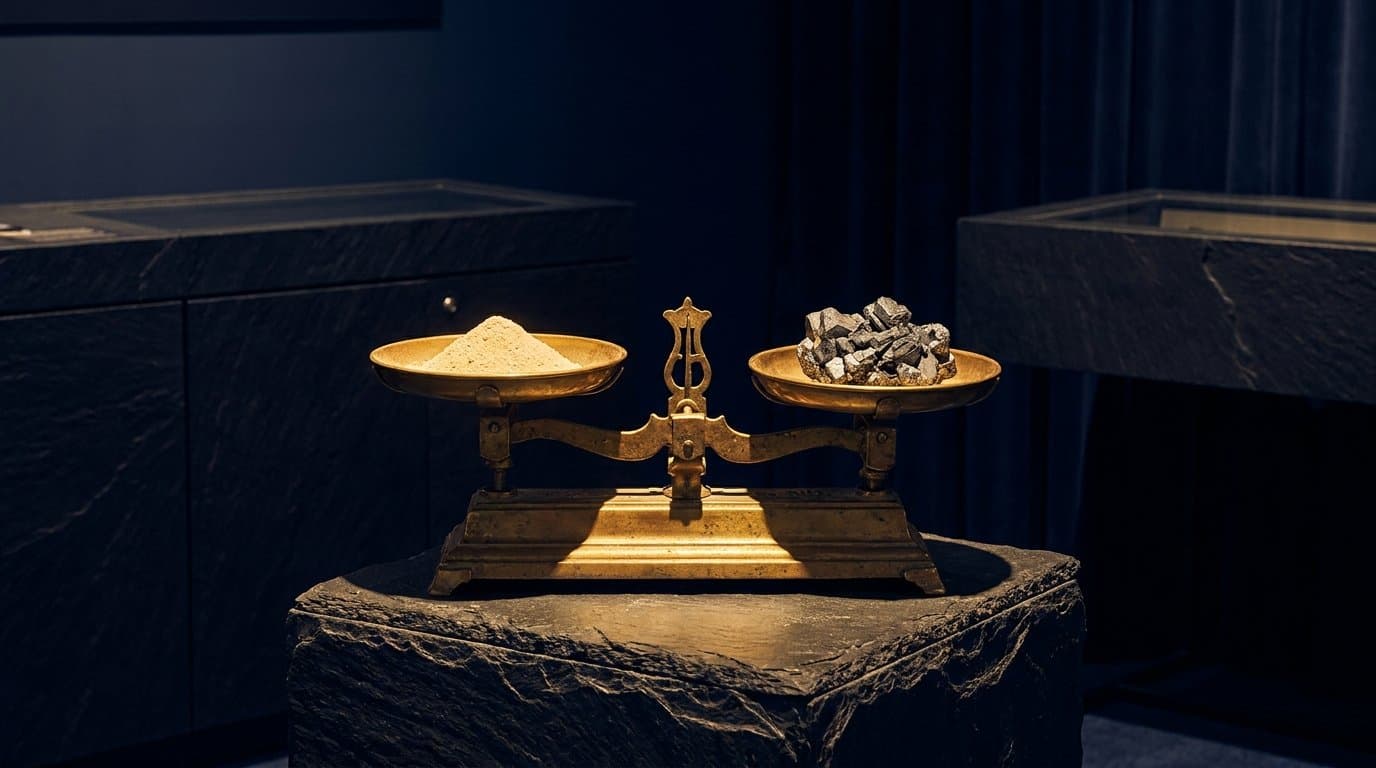
Every rare earth conversation eventually splits down one line: light versus heavy. The distinction sounds academic - it is based on atomic weight - but it drives everything commercial about these elements: where they come from, what they cost, who controls them, and which ones keep defense planners awake at night.
If you buy, sell or invest in rare earths, this is the taxonomy you must know cold.
The Dividing Line
The rare earths comprise the fifteen lanthanides plus scandium and yttrium. The industry divides the lanthanides by atomic number:
Light rare earth elements (LREE):
- Lanthanum (La), Cerium (Ce), Praseodymium (Pr), Neodymium (Nd), and usually Samarium (Sm)
Heavy rare earth elements (HREE):
- Europium (Eu), Gadolinium (Gd), Terbium (Tb), Dysprosium (Dy), Holmium (Ho), Erbium (Er), Thulium (Tm), Ytterbium (Yb), Lutetium (Lu) - plus Yttrium (Y), which is light in mass but geochemically behaves as a heavy
The split is not arbitrary chemistry trivia. Because heavier lanthanides have progressively smaller ionic radii, they concentrate in different minerals and deposits than the lights - which is where the commercial story begins.
Abundance: Why Heavies Are Genuinely Rare
Light rare earths are not rare at all - cerium is more common in the Earth's crust than copper. The heavies are a different matter:
- LREEs dominate the two great commercial minerals, bastnaesite and monazite (together >90% of world production), where heavies rarely exceed a few percent of REO
- HREEs concentrate in ion-adsorption clays (southern China, Myanmar) and xenotime - deposit types that are scarce, small and geographically concentrated
- Global dysprosium production is measured in hundreds of tonnes per year; terbium in the low hundreds. Compare cerium at tens of thousands of tonnes
Scarcity of economic deposits - not crustal abundance - is what makes heavies "rare," and no exploration boom has yet changed the map.
Applications: Different Jobs, Different Criticality
Light rare earths power the volume applications:
- NdPr - the heart of NdFeB permanent magnets (EVs, wind, electronics); the value engine of the whole industry, covered in our NdPr guide
- Cerium - glass polishing, catalysts, metallurgy
- Lanthanum - fluid catalytic cracking in oil refining, optical glass
Heavy rare earths are the performance additives nothing else can replace:
- Dysprosium & Terbium - added to NdFeB magnets so they retain magnetism at high temperature. An EV motor or offshore wind turbine magnet without Dy/Tb fails where it matters. There is no substitute.
- Yttrium - thermal-barrier ceramic coatings for jet engines, phosphors, specialty alloys
- Europium & Terbium - phosphors for displays and lighting
- Gadolinium - MRI contrast agents, nuclear applications
A single F-35 aircraft reportedly contains over 400 kg of rare earth materials, with heavies indispensable across its systems - which is why HREE supply is treated as a national-security question, not a commodity question.
Supply Concentration: The 98–99% Problem
Light rare earth supply is concentrated but diversifying: China refines ~90% of NdPr, but Mountain Pass (US), Mount Weld (Australia) and a pipeline of new projects produce meaningful and growing LREE volumes.
Heavy rare earths have no such diversification story yet:
- China separates an estimated 98–99% of the world's dysprosium and terbium
- Much of the feedstock comes from ion-adsorption clays in southern China and - controversially - Myanmar, whose exports flow into Chinese processing
- Ex-China heavy separation capacity (Lynas in Malaysia, projects in the US and Australia) is only beginning to ramp, with material volumes not expected until 2027+
When Chinese export controls tightened from 2025 onward, heavies were the immediate casualty: customs data showed terbium and dysprosium exports to some destinations falling to zero for months. The result was the most dramatic price bifurcation in modern metals history.
Prices: The Premium Tells the Story
Indicative mid-2026 relationships (levels move weekly; directionally durable):
| Element | Group | Indicative price | Note |
|---|---|---|---|
| Cerium oxide | Light | ~$1–2/kg | Structurally oversupplied |
| Lanthanum oxide | Light | ~$1–2/kg | Structurally oversupplied |
| NdPr oxide | Light | ~$110+/kg | The volume-value workhorse |
| Dysprosium | Heavy | ~$260+/kg | +25% in July 2026 alone |
| Terbium | Heavy | ~$1,180+/kg | Defense-critical |
And the crucial modern wrinkle: ex-China heavy rare earths have traded at 4–6 times Chinese domestic prices - buyers outside China pay extraordinary premiums for assured, compliant supply. For lights the premium exists but is far smaller.
What Each Group Means for a Concentrate Buyer
If you buy light rare earth concentrate (monazite, bastnaesite, mixed REO):
- Your value driver is NdPr share; heavies are a minor bonus
- Supply options are comparatively diverse - Southeast Asia, Australia, Africa, the Americas
- Pricing follows NdPr assessments with the basket math from our pricing guide
If you need heavy rare earths:
- Feedstock options are few: xenotime concentrates, select monazites with elevated heavy content, and clay-derived intermediates
- Every gram of assayed Dy, Tb and Y in a lot materially moves its value - demand full ICP breakdowns, never summary grades
- Expect premiums, licensing scrutiny and competition from strategic stockpilers
CriticalOre's monazite and xenotime-bearing lots from Southeast Asian mineral sands carry meaningful yttrium and mid-heavy values - itemized element-by-element in every Certificate of Analysis.
The Geology Behind the Divide: Why Heavies Are Where They Are
The commercial split traces to crystal chemistry. As lanthanide ionic radii shrink across the series (the famous contraction), the heavier elements fit less readily into the common rare earth mineral lattices - monazite and bastnaesite preferentially incorporate the larger light elements, which is why the two great commercial minerals run 90%+ light. The heavies concentrate instead where different rules apply: xenotime, whose yttrium-phosphate structure welcomes small ions; and ion-adsorption clays, where tropical weathering of granites strips rare earths into solution and re-adsorbs them onto clay surfaces - heavies included - in deposits mineable with ammonium-sulfate leaching rather than hard-rock processing.
That second deposit type explains the modern map: the granites and weathering profiles of southern China and northern Myanmar host the world's exploitable clay concentrations, giving those regions their heavy rare earth hegemony. Exploration elsewhere - Brazil's Serra Verde being the notable producing exception, with prospects across Africa, Southeast Asia and Australia - hunts analogous weathering systems, while xenotime credits in tin-belt tailings and mineral sands (our region's contribution) supply meaningful yttrium and mid-heavies today.
Frequently Asked Questions About Heavy and Light Rare Earths
Why is yttrium counted as a heavy rare earth when it's lighter than iron? Chemistry over mass: yttrium's ionic radius sits mid-heavy-lanthanide, so it travels geologically and chemically with dysprosium and its neighbors - same minerals, same separation behavior, same market grouping.
Which rare earths are actually scarce in crustal terms? Thulium and lutetium rank rarest among stable rare earths - yet even they exceed gold's abundance manyfold. Commercial scarcity is about economic deposits and separation capacity; for heavies, both are genuinely limited, making the 'rare' label commercially honest even where geochemically loose.
Do light rare earth deposits contain any heavies at all? Yes - fractions of a percent to a few percent of REO, recoverable as credits where separation economics allow. Buyers of monazite and xenotime-bearing concentrates should demand full-spectrum assay precisely because modest Dy/Tb/Y lines can carry outsized value.
Is samarium light or heavy? Conventionally grouped light (it sits at the boundary), but its market behaves niche-heavy: SmCo magnet demand from defense and aerospace gives samarium strategic pricing dynamics closer to the heavies than to cerium's commodity world.
Will new heavy rare earth sources break China's control this decade? Progressively, not suddenly: Brazil's clays are producing, Lynas has begun ex-China Dy/Tb separation, Australian and African projects advance. Meaningful volume shifts late-decade - until then, heavy premiums and Myanmar-linked volatility remain the market's structure.
Key Takeaways on Heavies vs Lights
- The split is commercial destiny: lights (La–Nd) are abundant volume; heavies (Eu–Lu plus Y) are scarce performance additives - prices, politics and premiums all follow the line.
- Geology drew the map: monazite and bastnaesite run 90%+ light; heavies concentrate in ion-adsorption clays and xenotime - deposit types that made southern China and Myanmar the world's heavy suppliers.
- Dy and Tb are the strategic core: no substitute exists for their high-temperature magnet role, supply is 98–99% Chinese-separated, and ex-China material has commanded 4–6x premiums.
- NdPr bridges the groups commercially: light by chemistry, strategic by demand - the value engine whose diversification is furthest advanced.
- Yttrium behaves heavy: ionic radius, not atomic mass, governs - and gives mineral-sands xenotime credits their outsized worth.
- Full-spectrum assay is non-negotiable: modest heavy lines in a light concentrate can carry decisive value; summary grades hide exactly what matters.
- Late-decade is the heavies' horizon: Brazilian clays, Lynas Dy/Tb and Australian projects shift the map progressively - until then, premiums and Myanmar volatility remain structural.
The Bottom Line
Light rare earths are a market; heavy rare earths are a strategic chokepoint. The lights give the industry its volume and NdPr its value; the heavies give it its geopolitics. Any sourcing strategy - and any intelligent reading of rare earth news - starts by knowing which side of the line an element sits on.
For concentrate with documented light and heavy element distributions from origins outside the chokepoint, request a quote - our assays itemize all seventeen elements, because in this market, the decimals are the deal.