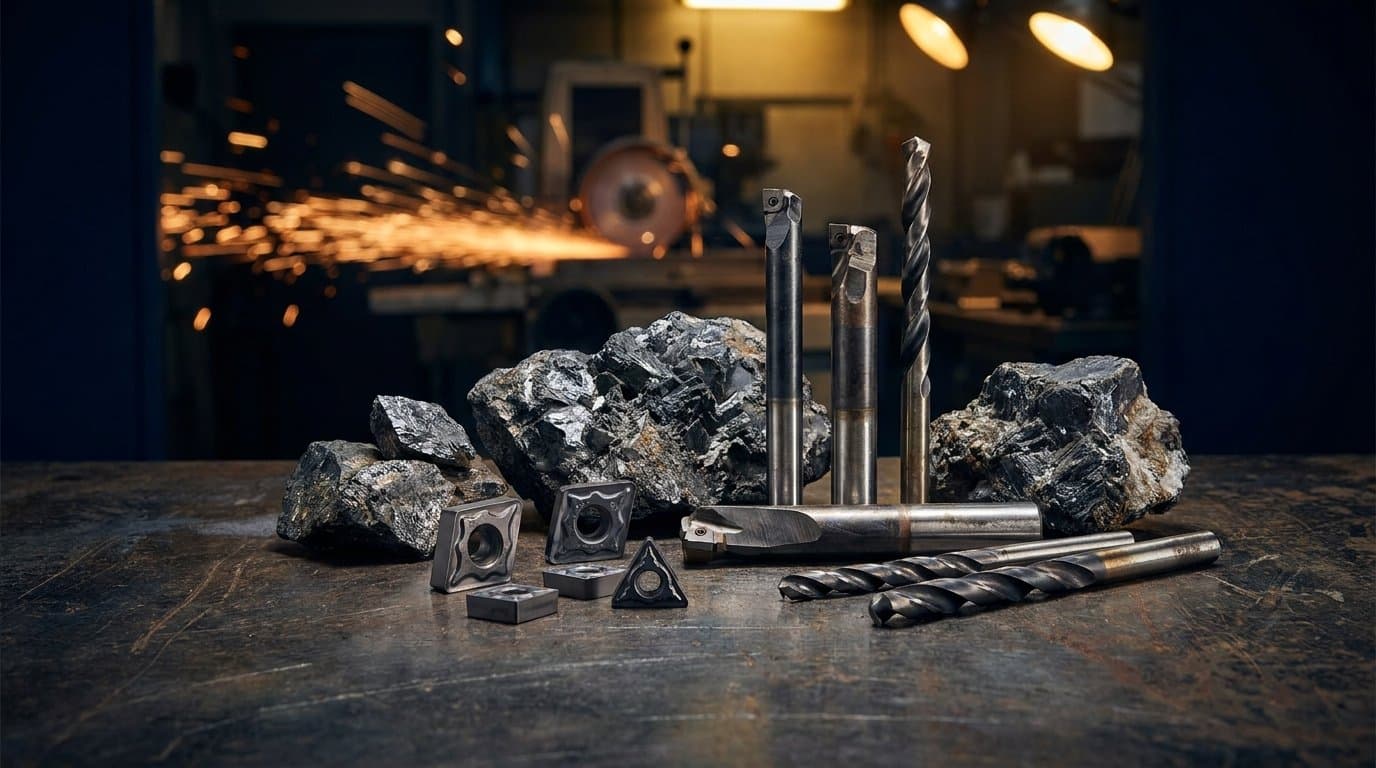
Tungsten holds records the periodic table cannot beat: the highest melting point of any metal (3,422°C), density matching gold, and - as tungsten carbide - hardness approaching diamond at industrial prices. Those superlatives make it quietly indispensable: nothing cuts, drills, mills or penetrates at scale without it.
They also make it strategic. Tungsten sits on every critical mineral list on earth - EU, US, UK, Japan, China - and in 2025 became one of the first minerals China formally export-controlled in the current era. Here is the complete guide for buyers and observers of the tungsten market.
Two Ores, One Metal
Commercial tungsten comes from two minerals, traded as concentrates graded on their WO₃ (tungsten trioxide) content:
Wolframite ((Fe,Mn)WO₄) - the classic hard-rock tungsten ore of Asia's tin-tungsten belts. Dark, dense, weakly magnetic (aiding beneficiation). Concentrates typically run 60–72% WO₃.
Scheelite (CaWO₄) - calcium tungstate, famous for fluorescing blue-white under UV lamps (still a prospecting tool). Concentrates typically 55–70% WO₃, with chemistry suiting certain processing routes.
Standard trade specification centers on WO₃ ≥65% for premium material, with penalty elements - tin, arsenic, phosphorus, sulfur, molybdenum - capped in contract. Our tungsten concentrate ships against exactly this framework, with per-lot independent assay.
Where Tungsten Goes
Cemented carbides (~60% of demand). Tungsten carbide (WC) bonded with cobalt forms the cutting edge of industrial civilization: machining inserts, mining picks, drilling bits, wear parts. Every factory, mine and oil rig consumes carbide daily - making tungsten demand a direct read on global industrial activity.
Steels and superalloys (~20%). High-speed steels and tool steels carry tungsten for hot hardness; nickel-base superalloys use it in turbine hot sections.
Mill products (~10%). Pure tungsten and heavy alloys: lamp-era filaments have given way to semiconductor sputtering targets, X-ray anodes, furnace elements, welding electrodes and radiation shielding.
Defense (~10% and rising). Density plus hardness equals kinetic energy penetrators; heavy alloys serve counterweights, armor solutions and hypersonic-relevant components. Rearmament cycles in Europe and Asia are adding a price-insensitive demand layer - the same pattern shaping rare earth defense demand.
Substitution is marginal everywhere it matters: molybdenum, ceramics and diamond tooling each cover niches, but nothing replicates tungsten's property set at its price.
The Supply Picture: Familiar Shape, New Urgency
- China: ~80% of mine production and a dominant share of downstream processing (APT - ammonium paratungstate - the key intermediate, plus carbide powders)
- The rest: Vietnam (Masan's Nui Phao, the largest ex-China mine), Russia (sanctions-complicated), Bolivia, Rwanda, Austria, Portugal, Spain, with revival projects in South Korea (Sangdong), Australia, Kazakhstan and the UK
- February 2025: China imposed export licensing on tungsten alongside other strategic metals - dual-use justification, immediate market effect. Prices firmed through 2025–2026, with July 2026 seeing continued gains amid the broad critical-minerals rally
- Western responses track the rare earth playbook: US DoD funding domestic processing, stockpile rebuilding, EU CRMA listing (CRMA guide), and buyers hunting documented ex-China units
Recycling matters more here than in most critical minerals - carbide scrap recycling supplies 30%+ of demand in mature markets, a genuine buffer but capped by scrap availability.
Reading a Tungsten Offer
Buyer's checklist for concentrate parcels:
- WO₃ grade and basis - dry basis, independently assayed (testing guide); premium ≥65%, tradable 55–65% with price adjustment
- Mineral type - wolframite vs scheelite affects downstream chemistry; state it
- Penalty elements - Sn, As, P, S, Mo against contract caps; APT converters penalize hard
- Physical form - gravity/magnetic concentrates vs flotation product; sizing
- Origin and compliance - tungsten is a 3TG conflict mineral under OECD/RMI frameworks: chain-of-custody and due-diligence documentation are mandatory for any Western-facing supply (responsible sourcing guide)
- Documentation set - COA, COO, packing list, B/L, MSDS (the full stack)
Pricing references APT quotations (Fastmarkets and peers publish European and Chinese assessments) with concentrate trading at a discount reflecting conversion - the same payable logic as rare earth baskets.
Southeast Asia's Quiet Advantage
The historic tin-tungsten belts running through Thailand, Myanmar and the Malay Peninsula still host wolframite and scheelite production and artisanal-to-industrial supply chains feeding regional aggregation. For buyers seeking ex-China units with proper documentation, the region - CriticalOre's home ground - offers grades, logistics (Laem Chabang outbound) and provenance that fit the moment. Regional context in our Southeast Asia hub guide.
Tungsten Market Dynamics Buyers Should Track
Beyond the fundamentals, four market mechanics shape every tungsten negotiation. First, APT is the price backbone: ammonium paratungstate quotations from Fastmarkets and Argus (published for both European and Chinese markets) anchor nearly all contract formulas, with concentrate typically settling at an agreed percentage of APT value per metric ton unit (mtu - 10 kg of WO₃). Learn to think in mtu terms: a 65% WO₃ concentrate contains 65 mtu per tonne, and offers quoted per mtu can be compared instantly across grades. Second, Chinese quota policy governs global availability much as it does in rare earths - production quotas, environmental inspections and export licensing each tighten or loosen the world market with little warning. Third, the Russian shadow: Russian tungsten, sanctions-complicated since 2022, moves through gray channels that periodically distort regional pricing - one more reason provenance documentation now carries commercial value. Fourth, scrap spreads: because carbide recycling supplies a third of Western demand, the spread between scrap and primary prices signals genuine tightness better than any headline.
Frequently Asked Questions About Tungsten Concentrate
What is an mtu in tungsten trading? A metric ton unit equals 1% of one tonne - 10 kg - of contained WO₃. Tungsten concentrate is conventionally priced in dollars per mtu, so a 65% WO₃ concentrate at $340/mtu is worth $22,100 per tonne before adjustments. Thinking in mtu normalizes offers across different grades.
Is wolframite or scheelite concentrate better? Neither is universally better - they suit different converters. Wolframite's iron-manganese chemistry and scheelite's calcium base behave differently in APT conversion. What matters commercially is grade, penalty elements and consistency; state your converter's preference in the RFQ and price accordingly.
Why do arsenic and phosphorus matter so much? APT converters face strict impurity ceilings, and penalties escalate sharply above contract caps because removal costs are real. A concentrate at 66% WO₃ with high arsenic can net less than a clean 62% material - another reason full independent assay beats headline grade.
Is tungsten really a conflict mineral? Yes - tungsten is the "W" in 3TG under the OECD framework and Dodd-Frank §1502. Any tungsten entering Western electronics, automotive or aerospace chains requires chain-of-custody documentation and, at the smelter level, RMI-conformant processing. Buyers should reject offers that cannot document origin.
How volatile are tungsten prices? Less spiky than rare earths, more than base metals. APT prices moved substantially through 2025–2026 on Chinese export licensing and defense stockpiling, and the structural setup - concentrated supply, rearmament demand, thin project pipeline - argues for a firm floor through the decade.
What contract terms are standard for concentrate? Formula pricing against a named APT assessment, percentage payability negotiated per grade band, penalty schedules for As/P/S/Sn/Mo, surveyor-supervised sampling with umpire provisions, and L/C payment for new relationships - the same architecture described across our buyer guides.
Key Takeaways for Tungsten Buyers
- Think in mtu. Tungsten concentrate prices quote per metric ton unit (10 kg WO₃); converting every offer to $/mtu normalizes comparison across grades instantly.
- Wolframite and scheelite both trade at 55–70% WO₃, with converter preference - not intrinsic superiority - determining which suits your chain; state yours in the RFQ.
- APT assessments anchor everything: Fastmarkets and Argus quotations (European and Chinese) drive formula contracts, with concentrate at negotiated percentages of APT value.
- Penalty elements decide net value: arsenic, phosphorus, sulfur, tin and molybdenum caps can make a clean 62% concentrate outvalue a dirty 66% - independent full assay is where the money is.
- February 2025's Chinese export licensing confirmed tungsten's strategic tier; defense restocking and rearmament budgets have added a price-insensitive demand floor since.
- 3TG obligations apply: tungsten requires OECD-aligned due diligence and RMI-conformant processing for Western chains - chain-of-custody documentation is part of the product.
- Recycling buffers but doesn't solve: carbide scrap supplies 30%+ of mature-market demand, capping upside spikes without changing the concentrated-supply fundamentals.
- Southeast Asia's tin-tungsten belt offers documented ex-China units with established logistics - the diversification math that brought you to this page.
One closing observation from the trading desk: tungsten's combination of exchange-free pricing, 3TG documentation burden and defense-linked demand makes supplier quality more decisive here than in almost any other concentrate market - the spread between a documented, assay-transparent counterparty and a gray-market one is measured in whole percentage points of realized value, every shipment.
Secure the Hard Stuff
CriticalOre supplies wolframite and scheelite concentrates at 55–70% WO₃ with independent assay, penalty-element screening, RMI-aligned chain-of-custody documentation and export handling from Thai ports - to carbide, APT and alloy supply chains worldwide.
Request a quote with your WO₃ specification and monthly requirement; firm, documented offers within one business day.