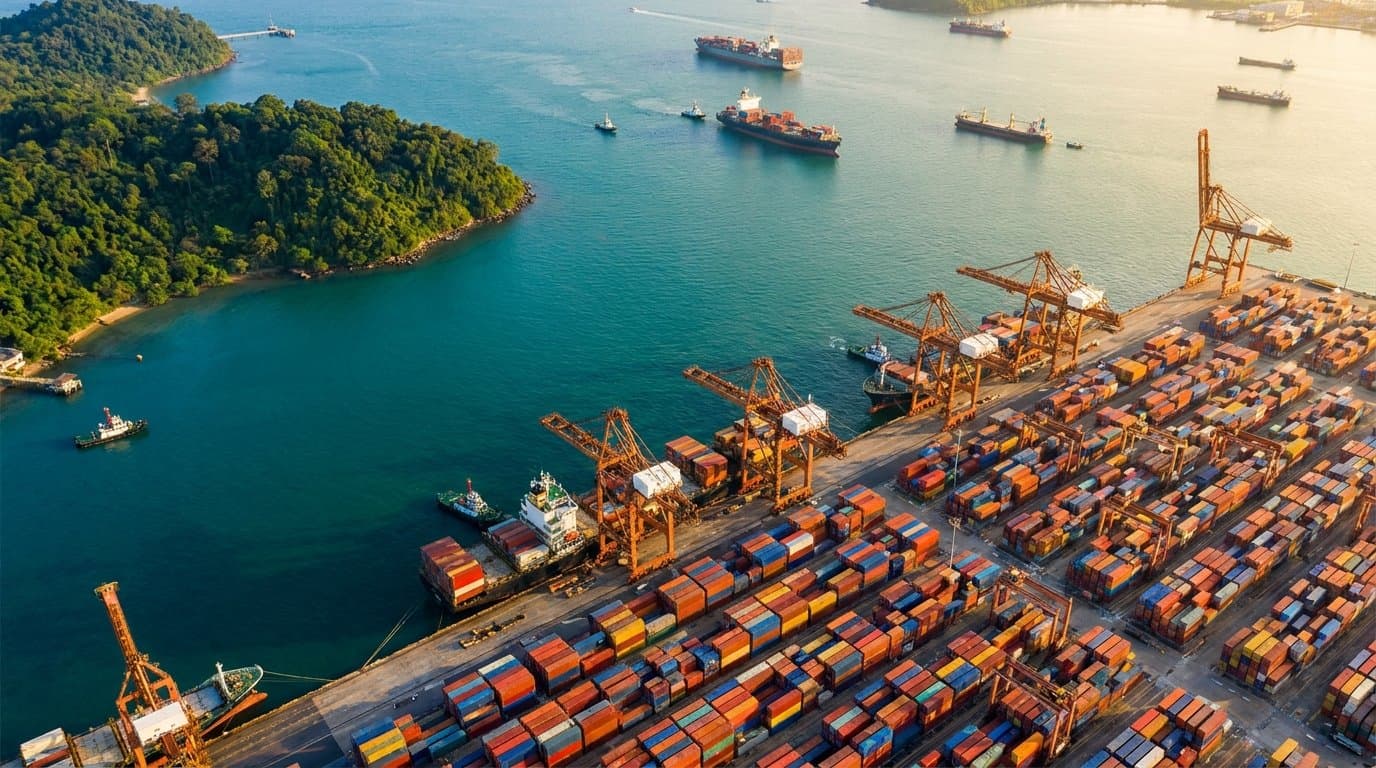
While policymakers in Brussels and Washington sketch mineral independence on decade-long timelines, the most consequential diversification of critical mineral supply chains is already operating - quietly, commercially - across Southeast Asia. The region that supplied the world's tin for a century is becoming something larger: the pragmatic middle ground of the ex-China minerals economy, where feedstock, processing and logistics converge outside the chokepoints but inside global shipping lanes.
Here is why Southeast Asia matters now, country by country and mineral by mineral - from a company that trades from its center.
The Geological Inheritance
The Southeast Asian granite belts - running from Myanmar through Thailand and the Malay Peninsula into the Indonesian tin islands - constitute one of earth's great metallogenic provinces:
- Tin - the world's historic supply belt, still producing from primary mines and, importantly, from a century of tailings whose reprocessing yields modern cassiterite concentrate
- Tungsten - wolframite and scheelite throughout the belt, companion to the tin (tungsten guide)
- Rare earths - the belt's granites and coastal heavy mineral sands host monazite and xenotime; tin-tailings recovery makes the region one of the few places on earth where NdPr-bearing feedstock is produced today outside dominant-supplier control (monazite guide)
- Antimony - stibnite occurrences through Thailand, Myanmar and Laos feeding regional aggregation (antimony analysis)
- Plus ionic-clay rare earth deposits in Myanmar (globally pivotal for heavies, with all the governance caveats), Vietnamese reserves among the world's largest on paper, Indonesian nickel's gravitational pull on battery chains, and Philippine copper-gold
The Processing Pivot: Malaysia and Thailand
Geology made the region a source; the 2020s are making it a midstream:
Malaysia hosts the anchor asset - Lynas Advanced Materials Plant in Kuantan, the largest rare earth separation facility outside China, processing Australian concentrate into separated oxides for a decade and now expanding into heavy rare earth separation. Around it: a US defense-linked supply deal (currently under governmental review - sovereignty politics attend everything in this sector), and in 2026, France's Carester announcing a 13,000-tonne separation plant in Perak. Malaysia is assembling the ex-China midstream piece by piece.
Thailand pairs industrial infrastructure with trading geography: established smelting heritage (tin via Thaisarco), chemical industry capable of mineral processing, the region's premier logistics platform - Laem Chabang port's direct services to Europe, East Asia and the Americas - and a commercial ecosystem (CriticalOre among it) aggregating, verifying and exporting the belt's minerals with documentation Western compliance regimes require. Announced rare earth processing ventures suggest Bangkok intends a larger midstream role.
Vietnam holds world-class reserves (Dong Pao) and magnet-manufacturing FDI, though its rare earth sector's development has been slowed by governance resets. Indonesia applies its nickel-era playbook - export restrictions forcing downstream investment - with tin, and holds monazite stockpiles from tin processing whose mobilization is a when, not if.
Why Buyers Route Through the Region
For Western procurement teams executing ex-China diversification, Southeast Asia offers a combination no other region currently matches:
- Material that exists now - not feasibility-study tonnes: producing mines, operating tailings recovery, functioning aggregation - shippable this quarter
- Origin outside the chokepoints - chain-of-custody from ASEAN origins answers the single-supplier exposure question CRMA files and defense flow-downs ask
- Logistics built for trade - the world's busiest sea lanes, container services in every direction, ports experienced with mineral cargo including NORM-classified shipments (our logistics network)
- Cost-competitive processing - as separation capacity grows regionally, concentrate can become oxide without a China transit or a Western cost structure
- Neutral commercial ground - ASEAN's practiced non-alignment means supply relationships here survive superpower weather
The Honest Caveats
Professional buyers price the region's risks alongside its advantages: Myanmar-linked material carries governance and sanctions complexity that demands rigorous provenance discipline; regulatory frameworks for radioactive minerals vary by country and evolve; and resource nationalism (Indonesian-style downstream mandates, Malaysian licensing debates) periodically reshapes terms. The mitigation is the same everywhere: counterparties with verifiable chain-of-custody, compliance fluency and local depth - the standard our responsible sourcing framework describes.
Country Deep-Dive: What Each Jurisdiction Offers Buyers
Thailand functions as the region's commercial switchboard: stable trade infrastructure, EU-preferential origin documentation, chemical-industry capability, and Laem Chabang's direct services to Rotterdam, Hamburg and Antwerp. For buyers, Thai-origin aggregation means Western-standard contracts, L/C banking through international institutions, and NORM-capable export handling - the practical machinery of compliance-grade trade.
Malaysia offers the region's processing depth: Lynas's Kuantan separation plant (the ex-China industry's proof of concept), the incoming Carester Perak facility, established smelting (MSC for tin) and a regulatory framework with a decade of rare earth licensing experience - hard-won through public debate that produced clearer rules than most jurisdictions possess.
Vietnam is the reserves giant (second only to China on paper at Dong Pao and associated deposits) with magnet manufacturing FDI already operating - but upstream development has restarted repeatedly amid governance resets. Watch it as the decade's potential supply surprise rather than today's contract counterparty.
Indonesia brings scale and policy aggression: the nickel downstreaming playbook applied to tin (export restrictions forcing domestic refining), plus monazite accumulated from decades of tin processing - a rare earth inventory awaiting a policy decision to mobilize.
Myanmar remains the uncomfortable pivot: the world's swing supplier of heavy rare earth feedstock via ionic clays, flowing almost entirely into Chinese processing, with governance conditions that make direct Western sourcing effectively impossible. Its significance for buyers is indirect - Myanmar supply risk is priced into every dysprosium and terbium quotation on earth.
Frequently Asked Questions About Sourcing From Southeast Asia
Is Southeast Asian rare earth material really independent of China? Origin-level, yes - mineral sands and tin-belt production across Thailand, Malaysia and Indonesia is verifiably non-Chinese. Buyers requiring processing independence too should note most regional concentrate historically flowed to Chinese separators; the new Malaysian and Thai separation capacity is precisely what changes that equation.
How does monazite from the region compare with other sources? Competitively: 55–62% REO with solid NdPr fractions, from established heavy-mineral-sands and tailings operations with decades of production history. The thorium content requires NORM-licensed buyers - standard for monazite everywhere - and regional exporters experienced with IAEA-aligned shipping handle the logistics routinely.
What logistics advantages does the region offer European buyers? Direct weekly container services from Laem Chabang to North European ports (30–40 days), NORM-capable carriers and terminals, established surveyor networks (SGS, Bureau Veritas, Intertek all resident), and time zones allowing same-day communication with both European buyers and origin operations.
What due diligence specifics apply to the region? Standard OECD framework plus regional particulars: verify material is not Myanmar-transshipped where your compliance regime restricts it, confirm mining and export licensing per country, and require lot-level chain of custody - which reputable regional suppliers, ourselves included, provide as standard.
Key Takeaways on the Southeast Asian Hub
- The region supplies today, not someday: operating mineral sands, tin-belt and tailings production make Southeast Asia one of the few ex-China critical mineral origins with material flowing this quarter.
- Malaysia anchors the midstream - Lynas Kuantan plus the incoming Carester Perak plant make it the ex-China separation capital, with Thailand assembling its own processing ambitions.
- Thailand is the commercial switchboard: Laem Chabang's direct services, international banking, NORM-capable export handling and Western-standard documentation make Thai-origin aggregation the practical trade route.
- Vietnam and Indonesia are the optionality: world-class reserves and accumulating monazite stockpiles respectively - watch both as late-decade supply surprises.
- Myanmar prices the heavies globally even though direct Western sourcing is impossible; its supply risk is embedded in every dysprosium and terbium quotation.
- Due diligence has regional specifics: Myanmar-transshipment screening, per-country licensing verification and lot-level custody records separate bankable regional supply from gray-market noise.
- The strategic read: as supply chains bifurcate, geography that is non-aligned, logistics-rich and production-real becomes the network's indispensable node - and buyers plugging in early get the relationships that matter when tightness returns.
For procurement teams building regional strategies, the practical entry sequence mirrors our general buying guidance: qualify one Thai or Malaysian aggregation counterparty, trial a container with full documentation exercise, then scale into term supply as the relationship proves - the region rewards presence and patience over transactional opportunism.
The Strategic Read
The critical minerals map of 2030 will not be China versus a rebuilt West - it will be a networked system, and Southeast Asia is positioning as its indispensable node: feedstock from the belt and beyond, separation in Malaysia and Thailand, magnet and battery plants following, all seated on shipping lanes that serve every customer. UNCTAD's trade data already shows critical minerals reshaping global flows; this region is where the reshaping is physical.
CriticalOre was built for exactly this geography: Bangkok-based, sourcing rare earth, tin, tungsten and antimony concentrates from vetted regional origins, testing independently, documenting completely, and shipping worldwide from Laem Chabang.
The hub is operating. Request a quote and plug into it.