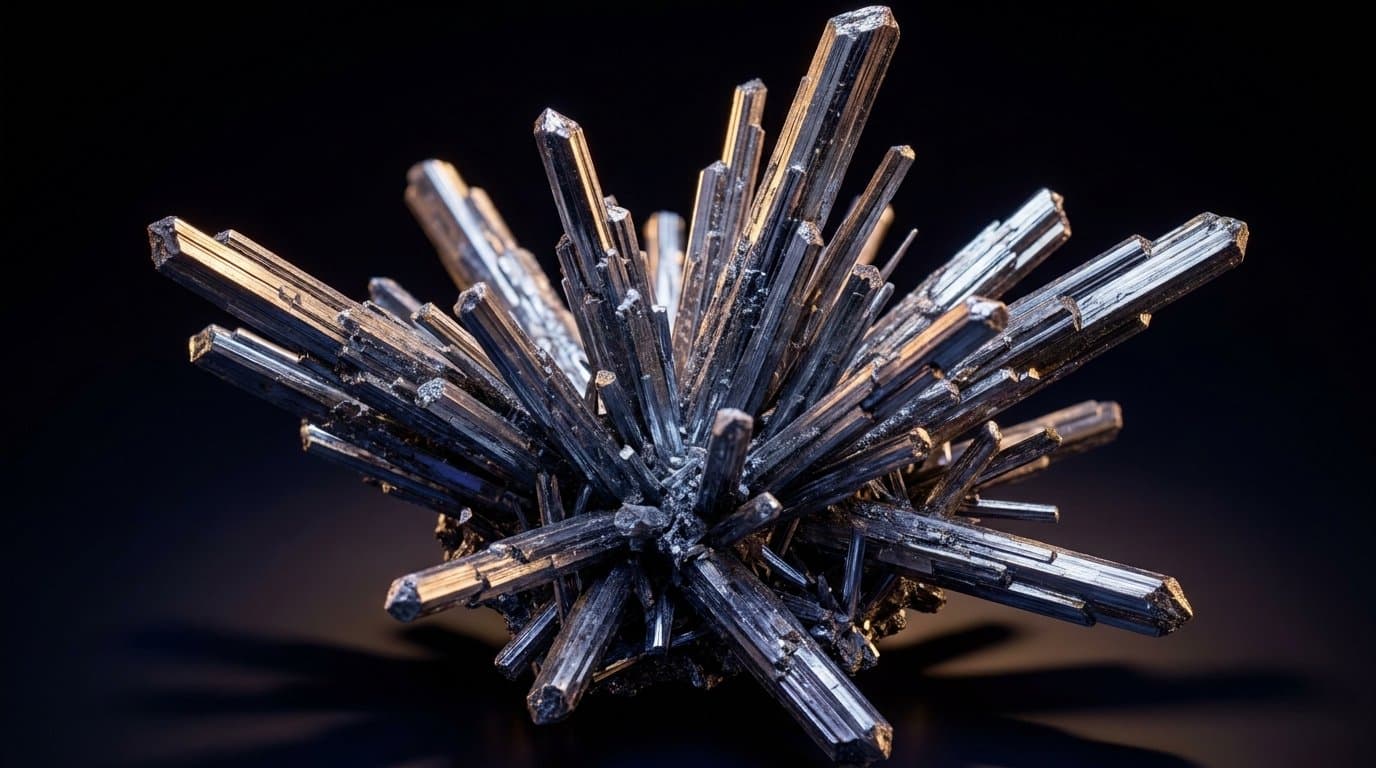
Five years ago, antimony was a trivia answer - element 51, a brittle silver metalloid mostly noticed by flame-retardant chemists. Today it is the case study every critical-minerals presentation opens with: prices multiplied severalfold, Western defense agencies scrambling, and a market so structurally short that every geopolitical tremor moves it double digits.
What happened to antimony is what can happen to any small, concentrated, irreplaceable mineral market. Here is the full story - and what buyers can actually do about it.
What Antimony Does
Antimony's demand profile is unusual: one dominant civilian use, several irreplaceable niches, and a defense role out of proportion to its obscurity.
- Flame retardants (~50% of demand). Antimony trioxide (ATO) is the synergist that makes halogenated flame retardants work in plastics, electronics housings, cables, textiles and building materials. Fire-safety regulation makes this demand rigid - nobody deregulates flammability
- Lead-acid batteries (~20%). Antimonial lead grids harden the workhorse batteries of cars, forklifts, telecom backup and grid storage in much of the world
- Photovoltaics. Antimony clarifies solar glass - a growth demand tied directly to the energy transition
- Semiconductors & electronics. Indium antimonide infrared detectors, phase-change memory, dopants
- Defense. Primers and munitions chemistry, hardened alloys, night-vision-relevant compounds - the applications that turned a commodity squeeze into a security file
Substitution is meaningful only at the margins; in flame retardancy and battery grids, decades of trying have produced partial workarounds at real cost, not replacements.
Anatomy of a Squeeze
Antimony's market was built to break:
- Small. Global mine production has run only ~80–100k tonnes per year - a rounding error beside copper, which is precisely why no slack exists
- Concentrated. China has dominated mining (~50%+) and utterly dominated smelting/processing; Russia and Tajikistan follow - a supplier list reading like a sanctions-risk index
- Depleting. Chinese ore grades have declined for years; environmental crackdowns idled capacity; no major new Western mine ramped in a generation
- Then weaponized. China imposed export licensing on antimony from September 2024, folded it deeper into the dual-use control regime in 2025, and squeezed flows to specific destinations as leverage. Exports to the West collapsed; Rotterdam prices decoupled from Chinese domestic quotes and multiplied
By 2025–2026, antimony had done what textbooks say impossible markets do: price rationing. Flame-retardant formulators reformulated where they could, battery makers passed costs through, and defense buyers paid whatever the ask was - while scrap antimony (recycled battery lead) became a strategic resource.
The Western Response
The playbook mirrors rare earths (the template), compressed:
- Stockpiling - US Defense Logistics Agency purchases; allied reserve programs
- Project revival - Perpetua Resources' Stibnite project in Idaho (DoD-backed) headlines a thin pipeline across Australia, Canada and Central Asia; timelines stretch toward decade's end
- Processing diversification - smelting/roasting capacity outside China is the true bottleneck; new plants announced in North America, Europe and Asia
- Recycling intensification - secondary antimony from lead-acid recycling loops, the one supply source that responds quickly
- CRMA/critical listings - antimony sits on the EU strategic list with everything that implies for documentation and diversification mandates (CRMA guide)
None of this closes the gap quickly. Antimony remains the tightest major critical mineral into the late 2020s on most credible forecasts.
Sourcing Antimony Now: The Practical Options
For buyers who need units rather than white papers:
- Southeast Asian stibnite. The Thai-Myanmar-Lao mineral belts host stibnite (Sb₂S₃) production feeding regional aggregation - one of the few ex-China origin stories with material flowing today. This is CriticalOre's terrain: our antimony concentrate runs 45–60% Sb with penalty elements screened per lot
- Concentrate over metal. With ex-China smelting scarce, many buyers secure concentrate and toll-convert; concentrate supply agreements also step around some metal-stage control regimes
- Documentation as qualification. Origin verification, chain of custody and full assay - with arsenic, lead and selenium itemized - separate bankable offers from the gray-market noise that floods every squeezed commodity
- Contract structure. Formula pricing against published assessments (Fastmarkets Rotterdam and peers), quantity tolerances and multi-shipment terms buy continuity in a market where spot chasing is punishment
Every practice from our buying guide applies doubled: scarce markets breed exactly the too-good offers that separate buyers from their deposits.
The Larger Lesson
Antimony is the proof case that "critical" is not rhetoric: small markets with concentrated supply and inelastic demand can reprice overnight and stay repriced. The buyers who navigated it best were those who had diversified before September 2024 - the same logic now driving ex-China sourcing strategies across every strategic mineral.
Lessons the Antimony Squeeze Teaches Every Mineral Buyer
Antimony's trajectory from obscurity to emergency is worth studying as a template, because its preconditions exist in a dozen other minerals. The market was small enough that no analyst desk covered it deeply; concentrated enough that one policy decision in Beijing repriced the world; inelastic enough that demand barely flinched at multiplied prices; and slow enough on the supply side that years later, the West's flagship response projects remain under construction. Bismuth, germanium, gallium and several heavy rare earths share every one of those traits - some have already had their own episodes.
The practical translations: treat small strategic markets as more dangerous than large ones, not less; hold physical buffer stock in anything both critical and concentrated; qualify secondary and regional sources before the squeeze, when qualification is cheap; and read export-control law as a leading indicator - materials added to licensing regimes have repriced within quarters, every time. The buyers who navigated antimony best were those who treated the September 2024 licensing announcement as the signal it was, rather than waiting for the price chart to confirm it.
Frequently Asked Questions About Antimony
What is antimony concentrate and what grades trade? Stibnite (Sb₂S₃) concentrate is the standard traded form, with 45–60% Sb typical commercial range. Arsenic, lead and selenium caps matter to smelters; full independent assay per lot is standard professional practice.
Why did antimony prices multiply so dramatically? A structurally short market met export restriction: China's September 2024 licensing regime, layered onto declining Chinese ore grades and years without new Western mines, collapsed available ex-China supply while flame-retardant and defense demand stood firm. Rotterdam prices decoupled from Chinese domestic quotes and reached multiples of pre-crisis levels.
Who are the alternative suppliers to China? Tajikistan and Russia (each sanctions-or-governance complicated), Bolivia, Turkey, Australia's developing projects, the US Stibnite project late-decade - and Southeast Asian stibnite production feeding regional aggregation, one of the few flows Western buyers can contract today with clean documentation.
Is antimony demand at risk from substitution? Marginally. Some flame-retardant systems can reformulate away from antimony trioxide at cost and performance penalties; battery grid alloys have partially shifted to calcium; but regulation-driven fire-safety demand and the solar-glass growth wedge keep the demand floor solid.
What should a first-time antimony buyer do differently? Everything from our concentrate buying guide, compressed: verify assay independently, use banking instruments not deposits, document chain of custody - and move faster than you would in a comfortable market, because in squeezed commodities, genuine offers do not wait.
Key Takeaways on Antimony
- Small, concentrated, inelastic - the crisis formula: ~100kt annual market, Chinese processing dominance, and demand anchored by fire-safety regulation and defense left zero slack when export licensing hit in September 2024.
- Prices multiplied and stayed multiplied, with Rotterdam decoupled from Chinese domestic quotes - the clearest demonstration yet that export-control announcements are leading indicators, not news to react to later.
- Stibnite concentrate at 45–60% Sb is the tradable form, with arsenic, lead and selenium caps governing smelter acceptance; full independent assay separates real offers from the gray-market flood every squeeze attracts.
- Ex-China options are thin but real: Southeast Asian stibnite aggregation ships today with clean documentation, while Western projects (Perpetua and peers) remain late-decade stories.
- Concentrate beats metal for many buyers - securing feedstock plus tolling steps around metal-stage bottlenecks and control regimes.
- Substitution stays marginal: reformulation trims edges in flame retardants, but regulation-driven demand and solar-glass growth hold the floor.
- The transferable lesson: bismuth, germanium, gallium and the heavy rare earths share antimony's preconditions - apply its playbook (buffer stock, early qualification, control-law monitoring) before their episodes, not after.
The forward question buyers should sit with: when the Western projects finally commission late-decade, will prices normalize? Partially at best - the flame-retardant and defense demand floor, depleted Chinese grades and the now-institutional export-control architecture argue for a structurally higher plateau rather than a return to obscurity. Plan procurement accordingly.
Antimony, Documented and Deliverable
CriticalOre supplies stibnite concentrate (45–60% Sb) from vetted Southeast Asian origins - independently assayed, penalty-elements screened, chain-of-custody documented, exported through Thai ports under FOB, CIF or DAP terms.
In the tightest market in critical minerals, verified supply answers within one business day: request a quote.