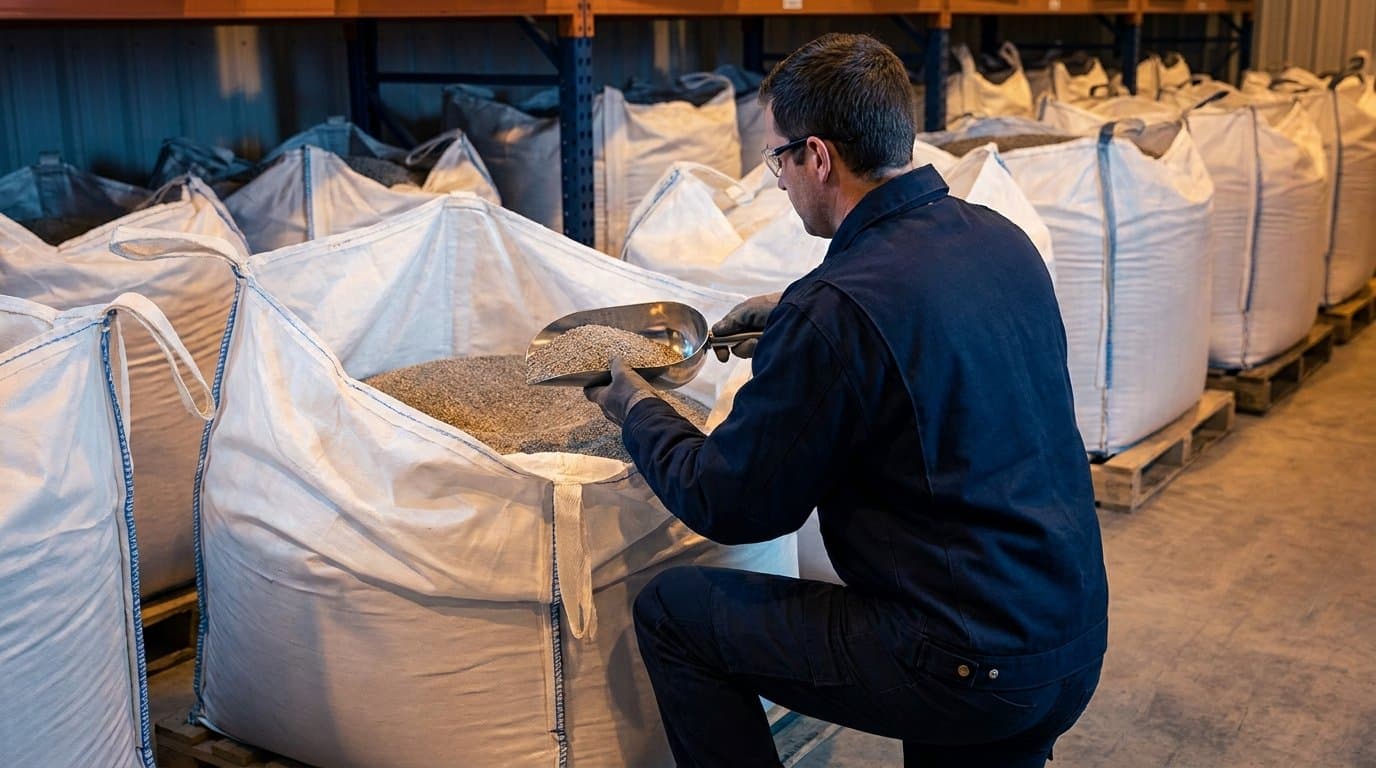
Buying rare earth concentrate for the first time is unlike buying most industrial commodities. There is no exchange, no standard product, and - thanks to the geopolitics surrounding critical minerals - no shortage of unserious intermediaries clogging the market. Yet thousands of legitimate transactions close every year between producers, traders and processors who follow a disciplined process.
This guide walks through that process step by step, from defining your requirement to receiving your first container.
Step 1: Define Your Requirement Precisely
Vague inquiries get vague answers. Before contacting any supplier, define:
- The mineral type - mixed rare earth concentrate, monazite, bastnaesite, or a specific carbonate? Your downstream process determines this.
- Target grade and element distribution - minimum total REO, minimum NdPr content, maximum thorium/uranium.
- Quantity and cadence - trial container first? 100 MT per month? A single spot parcel?
- Destination and incoterm - where must the material land, and who handles freight?
- Timing - when do you need first delivery?
A one-page specification sheet accelerates every subsequent conversation and signals to suppliers that you are a professional counterparty.
Step 2: Identify and Screen Suppliers
Real rare earth concentrate comes from a finite set of sources: operating mines, heavy mineral sands producers, tin-tailings processors and licensed aggregators in producing regions - chiefly China, Australia, the US, Myanmar, Vietnam, Thailand, Malaysia, India, Brazil and parts of Africa.
When screening a potential supplier, verify:
- Legal existence - company registration, tax records, office address you can verify
- Trading history - references from previous buyers, shipping records, years in operation
- Source transparency - which mine or producing region? Legal mining title or purchase agreements?
- Technical fluency - can they discuss element distribution, payables and umpire terms without hand-waving?
- Compliance posture - do they raise KYC, licensing and radiological documentation themselves, or wait for you to ask?
A supplier who volunteers compliance requirements is usually genuine; the shortcut-offering "facilitator" almost never is.
Step 3: Evaluate the Offer on Chemistry, Not Headlines
As we explain in our guide to rare earth concentrate, total REO percentage tells you little. Insist on a full ICP assay showing every element, then evaluate:
- NdPr content - the primary value driver for most buyers
- Heavy rare earth values - dysprosium, terbium and yttrium command premium prices
- Cerium/lanthanum share - abundant, low-value elements that dilute the basket
- Impurities - iron, phosphate, silica and fluorine affect processing costs
- Thorium and uranium - determine transport classification and licensing requirements
Ask when and where the assay was performed, and by whom. A reputable supplier provides recent, lot-specific analysis from a named independent laboratory - and welcomes your own testing.
Step 4: Sample Before You Commit
For any meaningful volume, request a representative sample of 1–5 kg drawn under documented procedure. Have it analyzed by your own laboratory or an independent facility (ALS, SGS, Bureau Veritas and Intertek all offer rare earth assay services).
Compare your results against the supplier's stated specification. Small variances are normal - rare earth assay at these concentrations has real analytical tolerance - but systematic discrepancies in the value drivers (NdPr, heavies) are disqualifying.
At CriticalOre, sample costs are typically credited against your first commercial order.
Step 5: Complete Mutual KYC and Compliance
Expect - and demand - a compliance phase before contracting:
- Corporate KYC in both directions: registration documents, ownership, banking references
- Sanctions screening of all parties
- End-use declaration - increasingly standard for strategic materials
- License verification - essential for monazite and other NORM cargoes, where you need import/processing authorization in your jurisdiction
This step protects you as much as the seller. A supplier who skips KYC will also skip documentation rigor elsewhere.
Step 6: Negotiate the Contract That Actually Matters
Rare earth concentrate is bought on contract terms, not handshakes. The clauses that decide whether your deal succeeds:
- Specification and rejection limits - the guaranteed assay, with clear franchises (tolerances) and price adjustments for deviation
- Pricing formula - fixed price, or index-linked against a named assessment (e.g., Fastmarkets NdPr oxide) with agreed payables
- Quantity and delivery schedule - with tolerance (e.g., ±10%)
- Sampling and analysis procedure - who samples, which lab analyzes, and umpire analysis provisions naming a third laboratory whose result binds both parties
- Payment terms - L/C at sight is standard for new relationships (see our letter of credit guide)
- Incoterm and risk transfer - FOB, CIF or DAP, per Incoterms 2020
- Documentation list - every certificate the seller must present, which for L/C transactions must match bank requirements exactly
Step 7: First Shipment - Verify Everything
For the inaugural shipment, spend the money on independent verification:
- Surveyor at loading - witnessing sampling, draft/weight, container condition and sealing
- Sealed umpire samples - retained by both parties and the surveyor
- Photo documentation - bags, labels, container interior, seals
- Radiological survey - documented, even for low-activity material
These measures typically cost a fraction of one percent of cargo value and eliminate the large majority of disputes. From the second shipment onward, most buyers scale back to standard COA plus periodic spot-checks.
Common Mistakes First-Time Buyers Make
- Chasing below-market prices. Genuine concentrate sells at market. Deep "discounts" signal either fraud or material that cannot pass compliance.
- Paying deposits without instruments. Use L/Cs or documentary collections. Wire-transfer deposits to unknown counterparties are how buyers lose money.
- Ignoring thorium. A cargo stuck at a European port for radiological non-compliance costs far more than doing licensing right the first time.
- Buying on total REO. Element distribution is the value. Always.
- Skipping the trial container. However good the paperwork, prove the supply chain end-to-end with one container before committing to volume.
How Long Does the Process Take?
For a prepared buyer working with an established supplier:
| Phase | Typical Duration |
|---|---|
| Inquiry to firm quote | 2–5 days |
| Sampling and buyer analysis | 2–3 weeks |
| KYC and contract | 1–2 weeks |
| Production/staging and loading | 2–4 weeks |
| Ocean transit (SE Asia to EU) | 4–6 weeks |
Roughly three to four months from first contact to material at your gate - which is why procurement teams anticipating 2027 feedstock requirements are contracting now.
After the First Shipment: Building a Supply Relationship That Compounds
The guide above ends where the real value begins - because in this market, the first container is an audition and the relationship is the asset. Practices that separate compounding partnerships from serial transactions: Debrief every shipment jointly - assay reconciliation, documentation friction, logistics performance - converting each container into process improvement. Graduate the terms: as history accumulates, L/C gives way to documentary collection or open-account-plus-standby, payables sharpen, and quantity flexibility widens - trust priced in, formally. Share forecasts: suppliers allocate scarce material toward buyers whose demand they can plan against; visibility is currency. Negotiate optionality: rights of first refusal on incremental volumes, index-linked multi-year frames with reopeners, trial access to new products from the supplier's development pipeline. Visit: origin inspections and buyer-facility tours convert counterparties into colleagues, and colleagues answer the phone during squeezes.
The 2025–2026 tightness wrote the case study: when export controls hit, allocation went to relationship buyers while spot seekers paid panic premiums or went without. In critical minerals, procurement excellence has quietly become relationship architecture - the checklist gets you the first container; the partnership gets you the fifth year.
Frequently Asked Questions About Buying Rare Earth Concentrate
What quantity should a first order be? One container (20–25 MT) is the professional trial standard - large enough to exercise the full chain (sampling, assay, documents, logistics, settlement), small enough to cap tuition. Samples precede it; volume follows it.
How do I evaluate a supplier I found online? Through the screening sequence above - registration, references, technical fluency, compliance posture - plus the meta-signal: serious suppliers interrogate you (end use, licensing, banking) as thoroughly as you interrogate them. One-way diligence marks a counterparty selling to anyone, which is its own answer.
Can individuals or small traders buy concentrate? Practically, entry requires an importing entity, banking capable of trade instruments, and for many materials, licensing - plus MOQ economics. Genuine small-scale participation usually means positions in producers or ETFs, not drums in a garage.
What margin do intermediaries add, and when are they worth it? Functioning intermediaries earn spreads by aggregating lots, bridging finance, holding licenses or absorbing logistics complexity - worth paying when they deliver capability you lack. Functionless daisy-chains, ubiquitous in this sector's gray market, add only risk; count the value-adding hands between mine and you.
How far ahead should I contract for 2027–2028 needs? Now is not rhetorical: separation capacity ramping through 2027 is contracting feedstock currently, and buyers anchoring term relationships in 2026 are buying ahead of that demand wave. Twelve-to-eighteen-month forward coverage, refreshed rolling, is the emerging professional baseline.
Start With a Real Offer
CriticalOre supplies rare earth, monazite and bastnaesite concentrates from vetted Southeast Asian sources, with independent assay, full export documentation and support for L/C payment. We work with first-time buyers regularly and will guide you through licensing and compliance where needed.
Request a quote - include your specification, monthly volume and destination port, and our commercial team will respond within one business day.