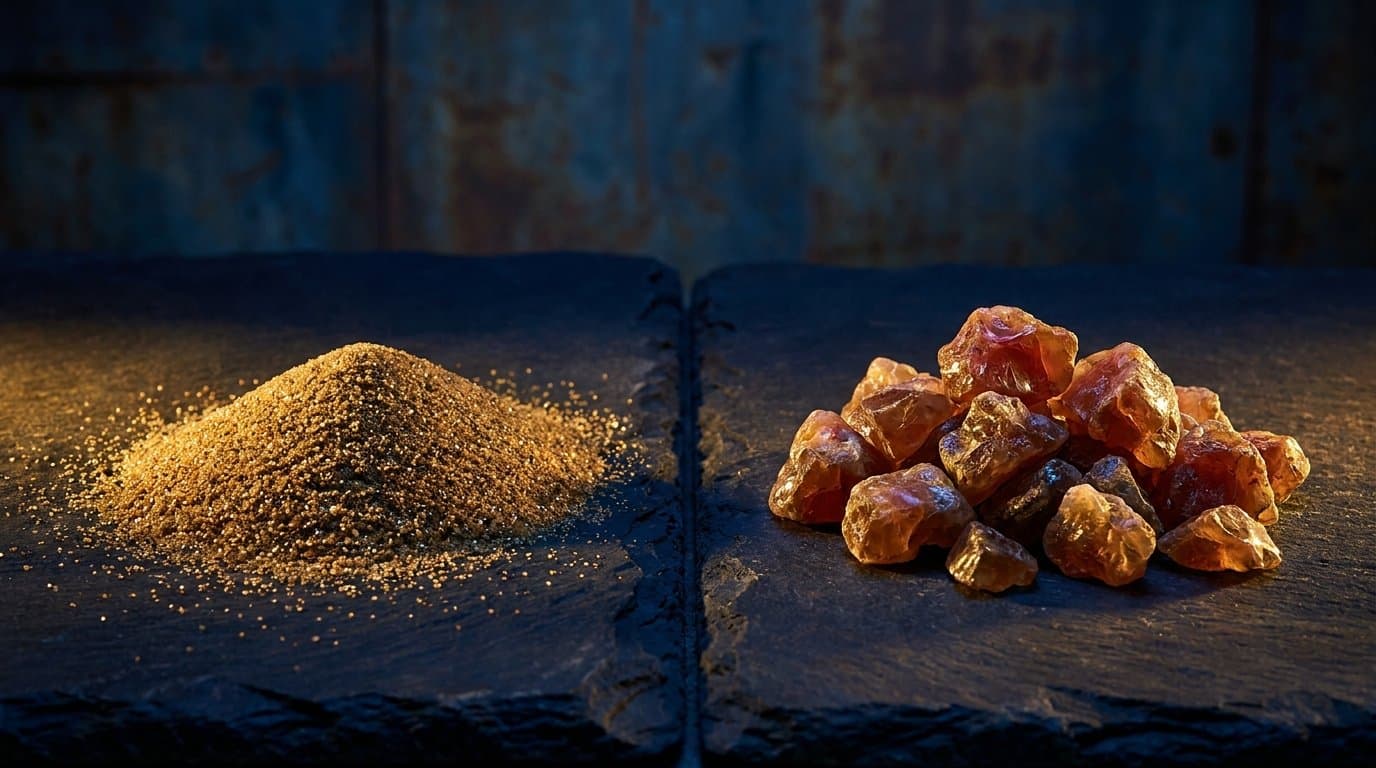
Monazite and bastnaesite are the two workhorses of the global rare earth industry - together they supply the overwhelming majority of the world's light rare earth elements. If you operate or feed a separation plant, sooner or later you will weigh one against the other.
The choice is not trivial. The two minerals differ in chemistry, radiological profile, processing route and regulatory burden - and picking the wrong feedstock can cost you months of licensing work or saddle your plant with waste-handling obligations it wasn't designed for.
Here is the complete comparison, from a supplier that trades both.
The Two Minerals at a Glance
| Property | Monazite | Bastnaesite |
|---|---|---|
| Chemistry | (Ce,La,Nd,Th)PO₄ - phosphate | (Ce,La)CO₃F - fluorocarbonate |
| Typical concentrate grade | 55–62% REO | 50–68% REO |
| NdPr share of REO | ~15–18% | ~15–20% |
| Thorium (ThO₂) | 4–7% | < 0.3% |
| Uranium (U₃O₈) | 0.1–0.4% | trace |
| Main sources | Heavy mineral sands (Asia, Australia, Africa, Brazil) | Hard-rock mines (China, USA) |
| Transport classification | Often NORM / Class 7 depending on activity | Usually unrestricted |
| Buyer licensing | NORM import & processing license required | Standard mineral import |
Composition: More Similar Than Different
Both minerals are dominated by the light rare earths. Cerium makes up roughly half the REO content in each, lanthanum 20–30%, and the magnet metals neodymium and praseodymium (NdPr) around 15–20%. Heavy rare earth content is modest in both, though monazite typically carries somewhat more yttrium and mid-heavy elements than bastnaesite.
From a pure basket-value perspective, the two minerals are often comparable at equal REO grades - the NdPr fraction drives value in both, and neither is a meaningful dysprosium or terbium source.
The real differences lie elsewhere.
Thorium: The Decisive Factor
Monazite contains 4–7% thorium oxide. That single fact shapes everything about how the mineral is traded:
- Lots are classified for transport based on measured activity concentration, frequently falling under NORM regulations and sometimes under Class 7 (radioactive) dangerous goods rules
- Buyers must hold import and processing licenses for radioactive materials in their jurisdiction
- Shipping requires gamma spectrometry testing, compliant packaging and labeling, and carriers willing to accept the cargo
- Processing generates thorium-bearing residues that require licensed management
Bastnaesite, by contrast, typically runs below 0.3% thorium - under regulatory thresholds in most jurisdictions for most lots. It ships as ordinary mineral cargo, clears customs without radiological licensing, and produces far less problematic waste.
This is why bastnaesite is often the default for buyers without radiological infrastructure, and why monazite - despite excellent chemistry - trades at a discount that reflects its compliance burden.
Why Buy Monazite Anyway?
If monazite is more complicated, why does a healthy market for it exist?
- Availability. Monazite is a by-product of heavy mineral sands operations that mine zircon, ilmenite and rutile - meaning steady, geographically diversified supply from Southeast Asia, India, Australia, Africa and Brazil, outside Chinese control.
- Price. The compliance discount means better value per unit of contained NdPr for buyers equipped to handle it.
- Thorium optionality. As thorium-based nuclear research advances, some processors view the thorium content as a future asset rather than pure liability.
- Established processing chemistry. Caustic or acid cracking of monazite is proven at industrial scale, with over half a century of operating history.
For separation plants already licensed for NORM feedstock, monazite is frequently the most economic light rare earth input available on the open market.
Processing Differences
The two minerals crack differently:
- Bastnaesite is usually processed by roasting (often with sulfuric acid) followed by leaching. The fluorine content requires management, but the flowsheet is simpler and the residues cleaner.
- Monazite requires more aggressive attack - traditionally hot caustic digestion to remove the phosphate and recover thorium/uranium separately, or sulfuric acid baking. The thorium must be safely deported into a managed residue stream.
If your plant flowsheet was designed for one mineral, switching to the other is a real engineering project - not a purchasing decision.
Regulatory Requirements Compared
For bastnaesite, buyer obligations are those of any mineral concentrate import: customs classification, origin documentation and standard safety data.
For monazite, expect to need:
- A NORM (or equivalent radioactive materials) import license
- A processing/handling license for your facility
- End-use declarations for the supplier's export process
- Radiation protection programs and monitoring at your site
- A plan for thorium-bearing residue management acceptable to your regulator
Reputable suppliers - ourselves included - will not ship monazite to unlicensed buyers. If a trader offers to "handle the paperwork" for you, walk away; the liability at the discharge port is yours.
Pricing: How the Two Compare
Both minerals price off their contained basket value with payables applied, as covered in our concentrate pricing guide. In practice:
- Bastnaesite earns higher payables (fewer complications, broader buyer pool)
- Monazite earns lower payables but often better absolute NdPr value for licensed buyers
- Both have seen prices rise substantially through 2025–2026 as ex-China feedstock demand accelerates
Which Should You Buy?
Choose bastnaesite if:
- You lack NORM licensing or don't want the 6–12 month process of obtaining it
- Your flowsheet is roast-leach oriented
- You need the widest logistics flexibility (any carrier, any port)
Choose monazite if:
- You hold (or can obtain) radioactive materials licenses
- Your plant handles caustic/acid cracking with thorium deportment
- You want the better-value NdPr units and diversified, sands-based supply
Many serious processors buy both, blending feedstocks to optimize cost per kilogram of separated NdPr oxide.
Processing Economics: The Cost Structures Behind the Choice
The mineral choice ultimately resolves into processing cost curves. Bastnaesite's roast-leach route runs on sulfuric acid, energy and comparatively forgiving residue management - variable costs track acid and reagent markets, and capital scales down acceptably, which is why smaller ex-China separators lean toward it. Monazite's caustic route consumes sodium hydroxide aggressively (with trisodium phosphate byproduct partially offsetting), demands corrosion-resistant plant, and carries the thorium-residue overhead - higher fixed compliance costs that amortize properly only at scale or against monazite's discounted feedstock pricing. Add recovery differences (both achieve 90%+ REO recovery when run well) and the equation each buyer solves is genuinely individual: licensed capacity, reagent access, residue pathways and target basket decide, not mineral fashion.
The market's revealed preference reflects exactly this: integrated, licensed processors quietly accumulate monazite for its value density, while newer entrants pay bastnaesite's cleaner premium as tuition. Both strategies work; mismatching mineral to capability is what doesn't.
Frequently Asked Questions About Monazite and Bastnaesite
Can a single plant process both minerals? With flowsheet flexibility designed in, yes - several majors blend feeds. Retrofitting a bastnaesite-only plant for monazite means adding caustic circuits and radiological licensing; the reverse is easier. Blend-capable buyers enjoy the widest feedstock market.
Which mineral offers better NdPr per dollar? Frequently monazite, after its compliance discount - the licensing moat suppresses competition for its units. Bastnaesite's premium buys simplicity. Run the basket math per actual offer; generalities lose to assays.
Are there other commercial rare earth minerals I should know? Xenotime (heavy-rich phosphate, premium feedstock), loparite (Russian niche), eudialyte and allanite (developmental), and ion-adsorption clays (not a mineral concentrate but the heavy rare earth workhorse). Monazite and bastnaesite remain the traded mainstream.
Does bastnaesite ever carry radiological issues? Lot-dependent: typically <0.3% ThO₂ keeps it under thresholds, but 'typically' is not 'always' - professional practice screens every lot regardless of mineral, and documentation travels with the cargo.
Which does CriticalOre recommend for a first-time rare earth buyer? Unlicensed buyers: bastnaesite or mixed low-thorium concentrate, full stop. NORM-licensed processors: monazite's economics usually win. Undecided: send us your flowsheet and licensing status - the recommendation falls out of the facts.
Key Takeaways on the Mineral Choice
- Chemistry similar, consequences different: both minerals deliver light rare earth baskets with strong NdPr, but thorium - 4–7% versus <0.3% - drives every commercial divergence.
- Bastnaesite buys simplicity: ordinary cargo status, standard import, cleaner residues - the default for unlicensed buyers and roast-leach flowsheets, priced at a premium payable.
- Monazite pays for capability: NORM licensing, caustic processing and residue stewardship earn discounted feedstock with superior NdPr economics - the licensed processor's quiet edge.
- Processing routes don't interchange: acid-roast versus caustic-crack plants are engineering commitments; match mineral to flowsheet before negotiating price.
- Supply geographies differ usefully: hard-rock bastnaesite (China, US) versus sands-based monazite (Southeast Asia, India, Africa, Brazil) - diversification logic favors holding both options.
- Blend-capable buyers win widest: plants accepting both feedstocks access the whole market and optimize cost per separated kilogram continuously.
- Send the flowsheet, get the answer: licensing status plus processing route makes the recommendation mechanical - which is exactly how we advise undecided buyers.
Sourcing Either Mineral
CriticalOre supplies both monazite concentrate (55–62% REO, full radiological documentation, licensed buyers only) and bastnaesite concentrate (50–68% REO, low-thorium) from vetted Southeast Asian origins. Every lot ships with independent ICP assay and complete export documentation.
Not sure which fits your operation? Contact our technical team - we will review your flowsheet and licensing position and recommend the right feedstock, with no obligation.