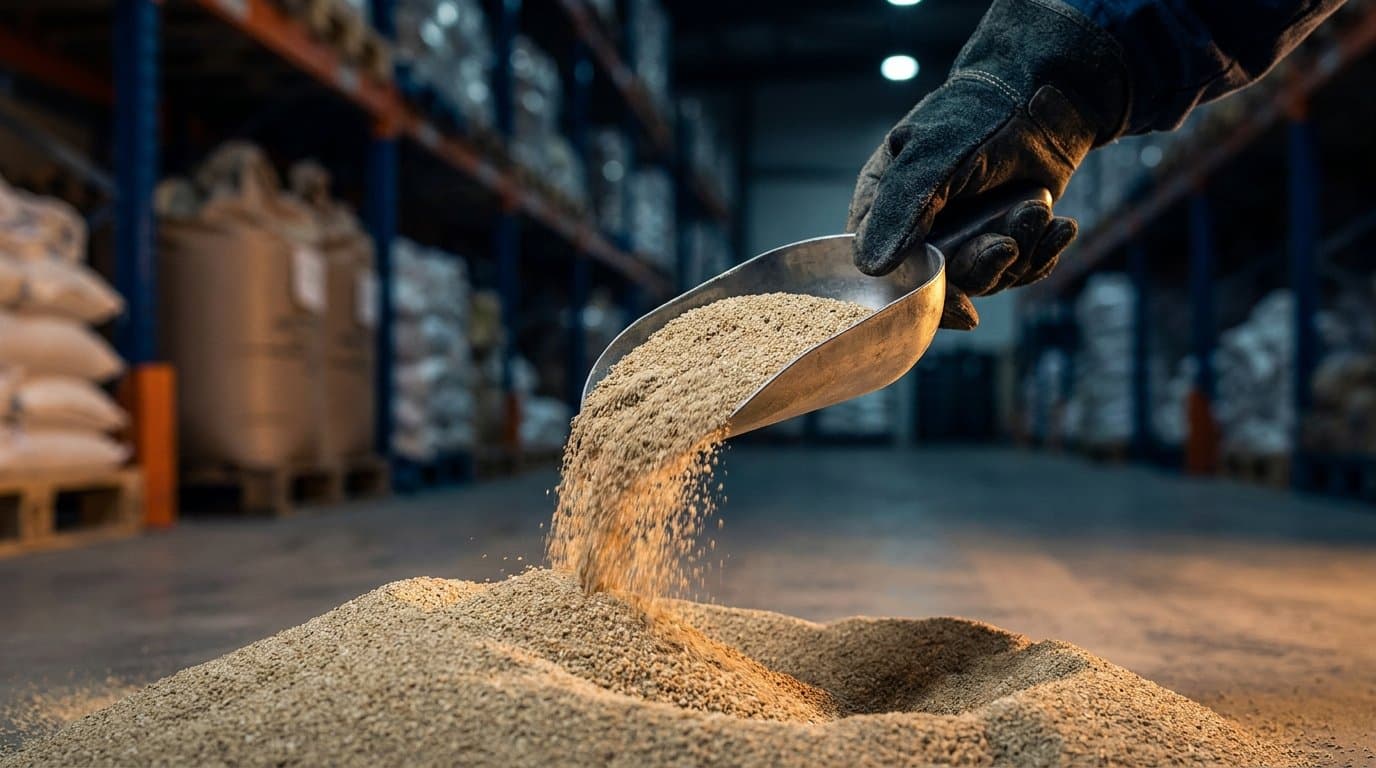
If you are sourcing raw materials for rare earth separation, magnet production or specialty chemicals, the product you will almost certainly buy first is rare earth concentrate - not the shiny separated oxides you see in laboratory photographs. Yet many first-time buyers arrive at the negotiating table without a clear picture of what concentrate actually is, how its value is calculated, or what separates a bankable offer from a waste of time.
This guide explains everything a procurement professional needs to know before buying rare earth concentrate, drawn from our experience supplying industrial buyers across Europe, Asia and the Americas.
Rare Earth Concentrate, Defined
Rare earth concentrate is ore that has been mined and physically upgraded (beneficiated) to increase its rare earth oxide (REO) content. Raw ore might contain only 1–10% REO. Through crushing, grinding, flotation, gravity and magnetic separation, producers raise that content to a commercially tradable level - typically 45–70% total REO.
The key word is physically. Concentration does not chemically separate the individual rare earth elements from each other. A concentrate still contains the full cocktail of lanthanides found in the source mineral - cerium, lanthanum, neodymium, praseodymium and the rest - locked in the original mineral structure. Chemical separation into individual oxides happens later, at dedicated separation plants using solvent extraction.
Concentrate is therefore the standard intermediate product of the rare earth supply chain: the form in which rare earths leave the mine and travel to the refinery.
The Main Types of Rare Earth Concentrate
More than 95% of the world's economic rare earth production comes from four mineral sources. As a buyer, the type of concentrate determines the element distribution, the impurity profile and the regulatory requirements.
Bastnaesite Concentrate
Bastnaesite ((Ce,La)CO₃F) is a fluorocarbonate mineral and one of the two dominant commercial sources of light rare earths. Typical concentrate runs 50–68% REO, with cerium around half the REO content, lanthanum 25–30%, and NdPr around 15–20%. Its major advantage: thorium content is usually below 0.3%, which keeps it out of radioactive transport classifications in most lots.
Monazite Concentrate
Monazite ((Ce,La,Nd,Th)PO₄) is a phosphate mineral, typically recovered from heavy mineral sands. Grades of 55–62% REO are standard, with a somewhat richer NdPr fraction than bastnaesite. The catch is 4–7% thorium oxide plus trace uranium, which makes monazite a NORM (Naturally Occurring Radioactive Material). Buyers need import and processing licenses, and shipments require radiological testing and compliant packaging. We cover this in depth in our monazite compliance guide.
Ion-Adsorption Clays
Southern China and Myanmar host clay deposits where heavy rare earths adhere to clay particles. These are the world's principal source of dysprosium and terbium. Clay-derived material trades differently - often as mixed rare earth carbonate rather than a classical mineral concentrate.
Xenotime
Xenotime (YPO₄) is a phosphate rich in yttrium and heavy rare earths, usually a by-product of tin mining in Southeast Asia. Volumes are small but strategically important.
How Rare Earth Concentrate Is Priced
Concentrate pricing confuses newcomers because there is no exchange price for "rare earth concentrate." Value is built up from the contained elements:
- Assay the lot. An independent laboratory determines the full rare earth element distribution by ICP-MS or ICP-OES.
- Value each element. Each oxide in the basket is priced against a published assessment (Fastmarkets, Asian Metal, SMM, Argus). Neodymium and praseodymium typically contribute 60–80% of the basket's value even when they are only 15–20% of the REO content. Cerium and lanthanum, though abundant, contribute little.
- Apply payables. Buyers do not pay 100% of the contained value - a percentage (the "payable") reflects separation costs, recovery losses and the impurity burden.
- Adjust for logistics and terms. FOB versus CIF, payment terms, lot size and delivery schedule all move the final number.
The practical implication: two concentrates with identical total REO can differ in value by a factor of two or more depending on their NdPr and heavy rare earth content. Never evaluate an offer on "% REO" alone - demand the full element distribution.
What a Serious Offer Looks Like
After years in this trade, we can usually tell within one email whether an offer is real. Genuine concentrate offers include:
- A full assay from a named, independent laboratory - not a screenshot of a generic table
- Element-by-element breakdown, including NdPr content and thorium/uranium values
- Clear origin and evidence of legal mining title
- Realistic quantities - offers of "10,000 MT/month of 70% REO" from unknown traders are fantasy
- Standard trade terms - L/C or documented escrow, incoterms, umpire analysis provisions
Red flags include prices dramatically below market, refusal to allow independent sampling, pressure to pay deposits before documentation, and vague or shifting origin stories.
Quality Verification: The Non-Negotiables
Because concentrate value depends entirely on chemistry, quality verification is where buyers should focus their diligence:
- Independent sampling at loading, following ISO standards, with sealed umpire samples retained
- ICP confirmation of the XRF screening values
- Moisture determination - you are paying for dry metric tons, and moisture also matters for safe carriage
- Radiological screening on every lot, even for "low-thorium" minerals - documented Bq/g values protect you at the destination port
- Umpire analysis clauses in the contract, naming a mutually acceptable third laboratory
At CriticalOre, every lot we ship carries a Certificate of Analysis from an independent laboratory, and we support SGS or Bureau Veritas inspection at the buyer's option.
Packaging, Shipping and Documentation
Rare earth concentrate ships as a dry bulk powder or granular material, almost always in 1 MT laminated jumbo bags with inner liners, loaded into sealed 20 ft containers. A typical container carries 20–25 MT depending on density and road weight limits.
The standard document set comprises the commercial invoice, packing list, Certificate of Analysis, Certificate of Origin, bill of lading and MSDS. Monazite and other NORM cargoes additionally require radiation survey reports and, depending on measured activity, dangerous goods documentation.
Transit from Southeast Asian ports to Northern Europe runs 30–40 days. See our logistics page for routes, ports and incoterm options.
Who Buys Rare Earth Concentrate?
- Separation plants - the primary buyers, converting concentrate into individual oxides via solvent extraction
- Trading houses - positioning material between origin and refineries, often financing the flow
- Governments and stockpile agencies - increasingly active as strategic reserves grow
- Processors with tolling arrangements - buying concentrate and paying a separator to convert it
Since China's export controls tightened, ex-China concentrate has carried significant premiums, and Western separation capacity under construction in Europe, the US, Australia and Southeast Asia is actively contracting future feedstock. For buyers, securing reliable concentrate supply now is a hedge against a tightening market.
Frequently Asked Questions
What is the difference between rare earth ore and concentrate? Ore is the raw mined rock, typically 1–10% REO. Concentrate is ore after beneficiation, upgraded to 45–70% REO - the tradable product.
Can I buy separated rare earth oxides instead? Yes, but separated oxides trade at much higher prices and mostly come from China. Most independent supply enters the market as concentrate.
What is a good REO grade? Anything above 45% is commercially standard; above 60% is high-grade. But element distribution matters more than total REO - insist on the full assay.
Is rare earth concentrate radioactive? Monazite concentrate is (4–7% ThO₂) and requires licensed handling. Bastnaesite and most mixed concentrates are typically below regulatory thresholds, but every professional shipment includes documented radiological screening.
Frequently Asked Questions About Rare Earth Concentrate
Does concentrate expire or degrade in storage? Chemically, rare earth concentrates are stable indefinitely - these are oxidized minerals that survived geological time. Commercial care centers on moisture (stored dry, lined bags, settlement weights) and lot integrity (sealed, labeled, documented). Well-warehoused concentrate trades years after production without discount.
Is there a minimum REO grade worth trading internationally? Freight economics set the floor: below roughly 30–40% REO, shipping costs consume too much contained value for intercontinental trade in most markets. The 45–70% commercial band exists because that is where beneficiation cost meets freight efficiency.
Can concentrate be blended to meet a specification? Routinely - aggregators blend lots to hit contract grades and distributions, legitimately when documented (component assays, blend records, final lot assay). Undocumented blending, by contrast, is how gray-market material acquires convenient certificates; chain-of-custody discipline distinguishes the two.
Who regulates rare earth concentrate trade internationally? No single body: national mining and export laws at origin, radiological frameworks (IAEA-derived) for NORM content, customs and trade law en route, and increasingly, strategic-materials regimes (export controls, CRMA-style monitoring) at both ends. The compliance perimeter is the sum - one reason experienced counterparties matter.
How is concentrate different from 'rare earth carbonate' offers I see? Carbonates (and chlorides) are chemical intermediates - outputs of cracking, one stage downstream of mineral concentrate, priced on contained REO with different impurity logics. Both trade legitimately; conflating them in negotiation signals inexperience to whichever counterparty isn't confused.
Glossary: Ten Terms Every Concentrate Buyer Uses
TREO - Total Rare Earth Oxides, the headline grade. Distribution - the element-by-element percentage breakdown within TREO; where value hides. Basket price - contained value computed element-by-element against published assessments. Payables - the negotiated percentage of basket value actually paid for concentrate. NdPr - neodymium-praseodymium, the value-driving pair. NORM - Naturally Occurring Radioactive Material, the regulatory category thorium content triggers. COA - Certificate of Analysis, the settlement document. Umpire sample - the sealed third sample that resolves assay disputes. Quotational period - the assessment-averaging window fixing formula prices. Chain of custody - documented material history from origin to delivery; the modern market's admission ticket.
Sourcing Concentrate from CriticalOre
CriticalOre supplies rare earth concentrate, monazite and bastnaesite from vetted Southeast Asian origins - independently assayed, fully documented and shipped worldwide under FOB, CIF or DAP terms. Whether you need a trial container or a multi-year offtake, our commercial team responds within one business day.
Request a quote with your target specification, quantity and destination port, and we will come back with a firm, documented offer.