Every discussion of rare earth supply eventually arrives at the same hopeful question: can't we just recycle them? The answer matters enormously - the EU has legislated a 25% recycling benchmark into the Critical Raw Materials Act, investors have funded dozens of recycling ventures, and headlines regularly announce breakthroughs.
The honest picture is more interesting than either the hype or the cynicism: rare earth recycling is real, growing and strategically important - and mathematically incapable of replacing primary supply for at least a decade. Here is why both halves are true, and what it means for anyone planning feedstock strategy.
The Startling Baseline
Less than 1% of rare earth elements were historically recycled - among the lowest rates of any metal group. Compare copper (~30%+ recycled content) or lead (batteries approach circularity) and the gap demands explanation:
- Dissipation - rare earths work in gram quantities: 2 g in a phone's speaker and haptics, scattered through shredder streams where recovery costs exceed value
- Chemistry - separating rare earths from a magnet's iron-boron matrix (then from each other) is genuinely hard chemistry (the same separation bottleneck that shapes primary supply)
- Collection economics - the valuable concentrations (EV motors, turbine generators) live inside products with 15–30 year lifespans, owned by someone else
- Historic price signals - cheap Chinese supply made recycling uneconomic for decades; the incentive only arrived with the export-control era
Where Recycling Actually Works
Magnet-to-magnet recycling is the serious frontier. NdFeB magnets (how they're made) concentrate NdPr and dysprosium at 30% by weight - the richest "ore" on earth if you can collect it:
- Short-loop routes - hydrogen decrepitation (HPMS and similar processes) turns recovered magnets back into alloy powder for new magnets without full chemical separation; operating at commercial pilot scale in the UK and Europe
- Hydrometallurgical routes - dissolve and re-separate to virgin-grade oxides; flexible on feed, heavier on chemistry, scaling in the US, Europe and Japan
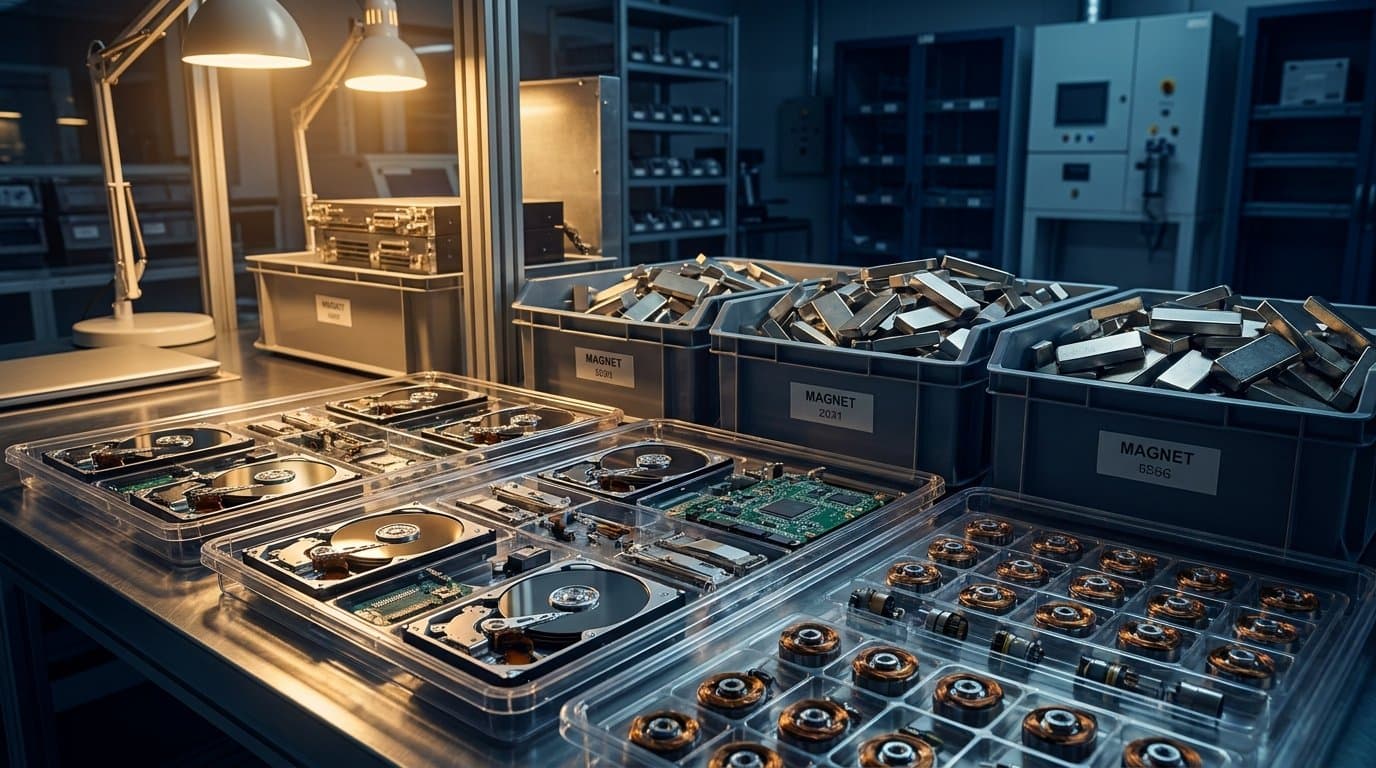
- Feedstock today - manufacturing swarf (magnet machining waste, historically shipped to China), hard drives from data-center decommissioning (a genuine, growing stream), and end-of-life industrial motors
Other loops: fluorescent phosphor recycling (Solvay's pioneering plant) declined with LED adoption; NiMH battery rare earths recover with the nickel; catalyst lanthanum/cerium partially loops within refineries.
The Arithmetic That Sets the Limit
The constraint no technology breakthrough changes: you can only recycle what society discards, and demand is growing faster than discards arrive.
- Rare earth demand grows 7–9% annually, driven by EVs and wind - products whose magnets entered service recently and retire in the 2035–2050 window
- Today's scrap pool reflects the much smaller magnet market of 2005–2015
- Even heroic collection assumptions leave recycled content supplying 10–15% of magnet rare earth demand around 2035, rising meaningfully only as the first EV/turbine retirement wave crests
The EU's 25% CRMA benchmark (the Act explained) is best read as directional policy: it forces collection infrastructure, design-for-recycling and processing investment now, so the 2035+ scrap wave meets capacity ready to swallow it.
Why Recycling Still Matters Strategically
Within its limits, recycling delivers things primary supply cannot:
- Heavies leverage - recycled magnets return dysprosium and terbium (the scarcest elements) at exactly the ratios demand needs - a hedge against the tightest chokepoint
- Domestic units - scrap is the one rare earth "deposit" every industrial economy already owns; no permitting decade required
- ESG arithmetic - recycled oxides carry a fraction of primary's footprint, strengthening responsible sourcing files
- Price discipline at the margins - every recycled tonne softens the demand curve primary suppliers face in squeezes
What It Means for Feedstock Strategy
For processors and buyers planning the next decade:
- Primary concentrate remains the backbone through the 2020s and well beyond - every credible model says so; recycling complements, it does not substitute
- Blend strategies win - the sophisticated 2030s feedstock portfolio mixes primary concentrate contracts, tolling, strategic stock and recycled streams as each matures
- Watch the swarf - magnet manufacturing growth in the West creates prompt scrap immediately; securing those loops is today's recycling opportunity
- Design signals matter - OEMs specifying recyclable magnet assemblies are writing the 2040 supply curve
The Recycling Project Landscape, Mapped
The venture map is filling in fast even while volumes stay modest. In Europe, magnet recycling pilots and first commercial plants operate in the UK (HyProMag's hydrogen-based short loop), Germany and France, with Solvay positioning La Rochelle as a recycled-feed separator alongside primary material. In North America, several funded ventures pair hydrometallurgical separation with magnet-maker offtakes, riding Inflation Reduction Act incentives and DoD interest in domestic Dy/Tb recovery. In Asia outside China, Japanese manufacturers - with two decades of quiet recycling practice behind them - run the most mature loops, particularly for manufacturing swarf and hard-drive recovery; Hitachi and others pioneered automated magnet extraction lines years before the West funded its first pilots. And China, characteristically, already operates the world's largest recycled rare earth industry - estimates put recycled NdPr at a meaningful share of its magnet feed - meaning the recycling race, like the primary one, starts from behind.
For feedstock strategists, the near-term significance is competitive rather than volumetric: recycled streams will first displace the marginal imported oxide in Western supply chains, and the players locking swarf and end-of-life collection contracts today are buying optionality on the 2030s scrap wave.
Frequently Asked Questions About Rare Earth Recycling
Which products are actually worth recycling for rare earths today? Manufacturing swarf (magnet machining waste, up to 30% of magnet material), hard disk drives from data-center decommissioning, industrial motor magnets, and MRI machines. Consumer electronics remain marginal - gram quantities dispersed across shredder streams defeat the economics.
Why can't recycling meet demand if magnets are 30% rare earth? Because today's scrap reflects the small magnet market of 15–25 years ago, while demand reflects the EV and wind boom of the last five. The material now entering service retires in the 2035–2050 window - recycling's volume decade, not this one.
Does recycled rare earth match virgin quality? Via hydrometallurgical routes, yes - output is separated oxide indistinguishable from primary. Short-loop alloy-to-alloy routes produce magnet-grade material for many applications, with some specification constraints. Qualification, not chemistry, is the usual adoption bottleneck.
What is the EU's 25% recycling target and is it achievable? The CRMA benchmarks 25% of EU strategic raw material consumption from recycling by 2030. For rare earths specifically, most analysts consider it aspirational on that timeline - but the collection infrastructure and processing capacity it forces into existence are exactly what the 2030s scrap wave requires.
Should buyers wait for recycled supply instead of contracting primary feedstock? No credible forecast supports that strategy. Through at least 2032, primary concentrate remains the backbone of every supply plan; recycled streams complement portfolios rather than replacing contracts. The sophisticated posture is securing both - primary term supply now, recycled offtakes as ventures mature.
Key Takeaways on Rare Earth Recycling
- Under 1% historical recycling rates reflect physics and economics - gram-scale dispersion, hard separation chemistry and decades of cheap primary supply - not lack of effort.
- Magnets are the real frontier: NdFeB's 30% rare earth content makes manufacturing swarf, data-center hard drives and industrial motors today's viable feedstock streams.
- The volume math is unforgiving: demand compounds at 7–9% while recyclable products retire on 15–30 year lags; recycled content plausibly covers 10–15% of magnet demand around 2035, not before.
- The EU's 25% CRMA benchmark is direction, not forecast - its function is forcing collection and processing infrastructure into existence ahead of the 2035+ scrap wave.
- Strategic value exceeds volumetric value: recycled streams return dysprosium and terbium at demand-matched ratios, sit inside domestic borders, and strengthen ESG files - worth pursuing even at modest tonnages.
- China leads here too, already operating the world's largest recycled rare earth industry - a reminder that circularity and supply security are separate problems.
- For buyers, the posture is both/and: primary concentrate contracts remain the backbone through the early 2030s, with recycled offtakes layered in as ventures mature and qualify.
The prudent reading for anyone allocating capital or contracts: treat recycling announcements as infrastructure news rather than supply news until tonnages ship, and audit any "recycled content" claims with the same lot-level rigor primary material demands - the certification frameworks are younger and looser than the marketing.
Watch also the policy accelerants now stacking up behind collection: extended producer responsibility schemes for magnets under EU discussion, design-for-disassembly clauses appearing in OEM specifications, and stockpile agencies quietly adding recycled-eligible language to purchase frameworks - each one shortens the distance between today's pilot economics and tomorrow's industrial baseline.
Both Sides of the Circle
CriticalOre supplies the primary feedstock the transition runs on today - rare earth concentrates with full assay and provenance - while the recycling infrastructure of the 2030s gets built. Buyers structuring long-term supply that anticipates both worlds are exactly who we like talking to.
Request a quote or contact our team to discuss multi-year feedstock strategy.