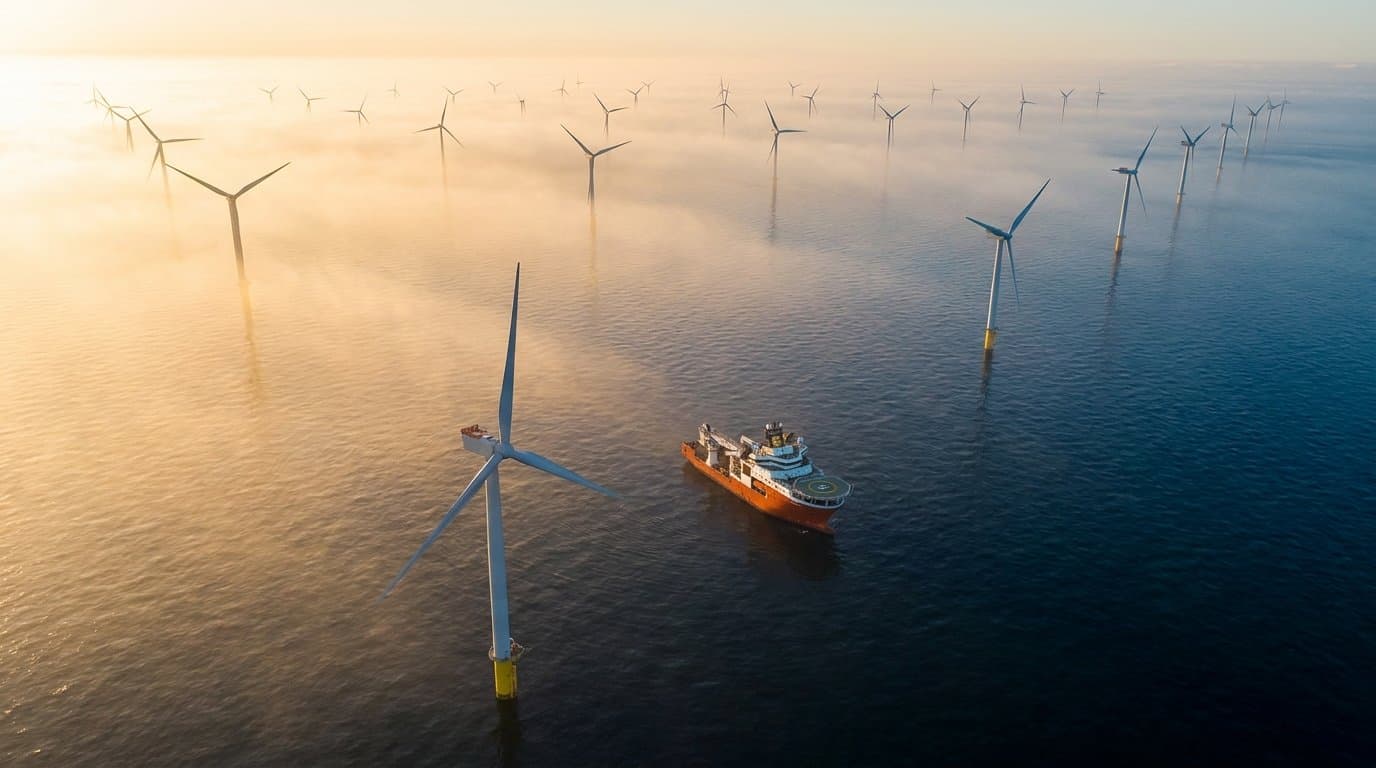
The wind industry sells clean electrons, but it buys minerals - and among its purchases, none is more strategically fraught than rare earths. A single large offshore turbine can contain several tonnes of NdFeB magnet material, making wind power one of the most rare-earth-intensive technologies humanity deploys, second only to the EV fleet in total demand.
Here is how rare earths power wind energy, why offshore turbines in particular depend on them, and what the industry's growth means for the supply chain feeding it.
Two Turbine Architectures, Two Mineral Stories
Wind turbines convert slow rotation (5–15 rpm at the rotor) into grid-frequency electricity, and the industry solved that conversion two ways:
Geared turbines use a gearbox to spin a conventional generator at high speed. Rare earth content: modest - some designs use small PM generators, many use none. The trade-off: gearboxes are the turbine's most failure-prone assembly, and a crane visit offshore costs a fortune.
Direct-drive turbines eliminate the gearbox entirely, coupling the rotor to a massive, slow-turning generator. To generate efficiently at low rpm, that generator needs an intense magnetic field in a huge diameter - which in practice means permanent magnet direct-drive (PMDD) with NdFeB magnets (how these magnets work).
Offshore, where reliability is worth its weight in helicopter fees, direct-drive has won: Siemens Gamesa's offshore platforms, GE's Haliade-X and much of the Chinese offshore fleet are PMDD machines.
The Quantities Are Enormous
Rule-of-thumb magnet intensities:
| Turbine type | Magnet mass per MW | Example: 15 MW offshore unit |
|---|---|---|
| PM direct-drive (offshore) | ~500–650 kg/MW | ~8–10 tonnes of NdFeB |
| Medium-speed PM hybrid | ~150–200 kg/MW | 2–3 tonnes |
| High-speed geared PM | ~30–80 kg/MW | ~1 tonne |
| Doubly-fed induction (geared) | ~0 | ~0 |
NdFeB magnet material is roughly 29–31% rare earths - overwhelmingly NdPr, with dysprosium/terbium additions so magnets survive decades at operating temperature inside a sealed nacelle over the North Sea (why heavies matter).
Translate to the element level and a single 15 MW offshore turbine embodies roughly 2.5–3 tonnes of neodymium-praseodymium plus tens of kilograms of heavies. A 1 GW offshore wind farm: on the order of 150–200 tonnes of NdPr. Global offshore pipelines measured in hundreds of gigawatts imply rare earth demand rivaling - and by some forecasts exceeding - everything except EVs.
Why Wind Accepts the Dependency
The industry knows its rare earth exposure and keeps choosing PMDD offshore anyway, for hard-nosed reasons:
- Reliability economics - removing the gearbox removes the top source of major offshore failures; over a 25–30 year life, avoided interventions dwarf magnet costs
- Efficiency at partial load - permanent magnets excel exactly where real wind operates most hours
- Mass and nacelle design - at 15+ MW scale, PMDD packaging wins
- Serviceability doctrine - fewer rotating subsystems suits far-from-shore projects
Onshore, where cranes are cheap, geared designs with little or no rare earth content remain fully competitive - one reason wind's aggregate rare earth intensity is an offshore story.
The Supply Chain Problem Wind Shares With Everyone
Wind's magnet supply runs through the same funnel as EVs and defense: China refines ~92% of NdPr, separates ~99% of Dy/Tb and manufactures ~90% of NdFeB magnets (the full story). The 2025–2026 export-control era made the exposure explicit for turbine OEMs just as it did for automakers - with the added irony that Western energy-security policy (offshore wind buildout) was discovered to depend on the very concentration other policies (CRMA, G7 targets) exist to reduce.
Industry responses now in motion:
- Long-term magnet and metal offtakes by turbine OEMs, some reaching upstream to separators and miners
- Qualification of ex-China magnet supply as US and European plants ramp
- Dy-thrifting via grain-boundary diffusion, cutting heavy loadings per magnet
- Turbine-scale recycling planning - decommissioned PMDD generators are the richest "urban ore" ever buried in a nacelle, though volumes arrive only when today's fleet retires (recycling timelines)
What Wind Demand Means for the Feedstock Market
For the upstream - where CriticalOre operates - wind adds a distinctive demand layer:
- Bulk NdPr units, contracted long - wind projects are financed on 25-year horizons and procure accordingly; separators feeding turbine magnet makers seek multi-year concentrate supply, not spot parcels
- Heavy rare earth credits matter - offshore thermal specs keep Dy/Tb in the recipe; feedstocks with documented heavy distributions (like monazite/xenotime-bearing mineral sands material) earn their premiums
- Compliance-grade documentation - energy developers inherit ESG and origin scrutiny from public financing; chain-of-custody from responsibly sourced origins is entering turbine procurement flow-downs
- Growth arithmetic - every credible scenario adds tens of thousands of tonnes of annual NdPr demand from wind by the 2030s, against a supply base still under construction
Auction Economics Meet Mineral Reality
Wind's rare earth demand arrives through a policy machine: government auctions award capacity years ahead of construction, creating unusually forecastable mineral requirements - and unusually visible collisions when mineral reality intrudes. The offshore cost crisis of recent years (inflation, supply chains, rate rises) already forced auction redesigns across Europe; magnet material availability now joins the risk register. Developers bidding 2026 auctions for 2030 commissioning are implicitly betting on NdPr and dysprosium supply chains that don't yet exist at required scale outside China - a bet some are hedging by demanding origin-flexible magnet strategies from turbine OEMs, and others by simply accepting Chinese supply with eyes open.
The turbine makers sit in the squeeze's center: Western content rules tightening on one side, Chinese magnet dominance on the other, and heavy rare earth exposure - the sharpest constraint - hardest to hedge. Watch the sector's contracting behavior as the leading indicator: when turbine OEMs start signing decade-length magnet-material offtakes with named origin requirements, the mineral market's structure will have permanently changed. Early signs suggest exactly that migration.
Frequently Asked Questions About Wind Turbine Rare Earths
Do all wind turbines contain rare earth magnets? No - most onshore turbines use geared drivetrains with induction or wound-rotor generators containing little or no rare earth material. The heavy dependence is offshore, where direct-drive permanent magnet architectures dominate for reliability reasons.
Why do offshore turbines specifically need dysprosium? Sealed nacelles over warm seas, decades of continuous operation, and catastrophic intervention costs mean offshore magnets must hold performance at sustained temperature without maintenance. Dysprosium (or terbium) additions provide exactly that thermal coercivity - the same physics driving EV motor recipes, at larger mass scale.
Could wind switch away from permanent magnets if prices spike? New designs could - superconducting generators and advanced geared architectures exist - but turbine platforms take a decade to develop and certify, and installed fleets are locked for 25+ years. Wind's rare earth demand is effectively committed through the 2030s regardless of price.
How does turbine decommissioning affect future supply? PMDD generators are the most concentrated rare earth objects ever deployed at scale - multi-tonne magnet assemblies in known locations with documented ownership. When today's offshore fleet retires (2040s), it becomes recycling's premier feedstock; pilot recovery programs are already staking positions.
What should suppliers to the wind chain prepare for? Energy-sector procurement standards: long-horizon contracts, ESG documentation inherited from project financing, origin traceability entering flow-downs, and volume commitments that reward scale and reliability - the compliance-heavy, relationship-driven pattern our responsible sourcing guide describes.
Key Takeaways on Wind and Rare Earths
- Offshore direct-drive is the dependency: ~600 kg of NdFeB per MW makes large offshore turbines the most rare-earth-intensive machines deployed - a 15 MW unit embodies 2.5–3 tonnes of NdPr.
- Reliability economics chose the magnets: eliminating gearboxes where cranes cost fortunes justifies the material bill - and locks the demand in for 25-year asset lives.
- Dysprosium rides along: sealed nacelles at sustained temperature require heavy rare earth additions, tying wind growth to the market's scarcest supply corner.
- Onshore is the hedge that exists: geared architectures with minimal rare earth content stay competitive where service access is cheap - wind's aggregate exposure is an offshore story.
- Auction pipelines make demand forecastable - and collisions visible: 2026 bids for 2030 commissioning implicitly bet on supply chains still under construction.
- Decommissioning is the future mine: multi-tonne magnet assemblies in documented locations make retired PMDD fleets recycling's premier feedstock - from the 2040s.
- Energy-sector procurement standards apply upstream: long horizons, ESG documentation and origin traceability flow down from project financing to every material supplier - prepare accordingly.
Supplying the Energy Transition's Backbone
The turbines decarbonizing grids are built from minerals that must be mined, concentrated, separated and documented - today. CriticalOre supplies that first tradable link: rare earth concentrates with independently assayed NdPr and heavy element values, from Southeast Asian origins outside the supply chain's chokepoints, with documentation built for energy-sector procurement.
Feeding the wind value chain - or securing against its squeeze? Request a quote and our commercial team will respond within one business day.