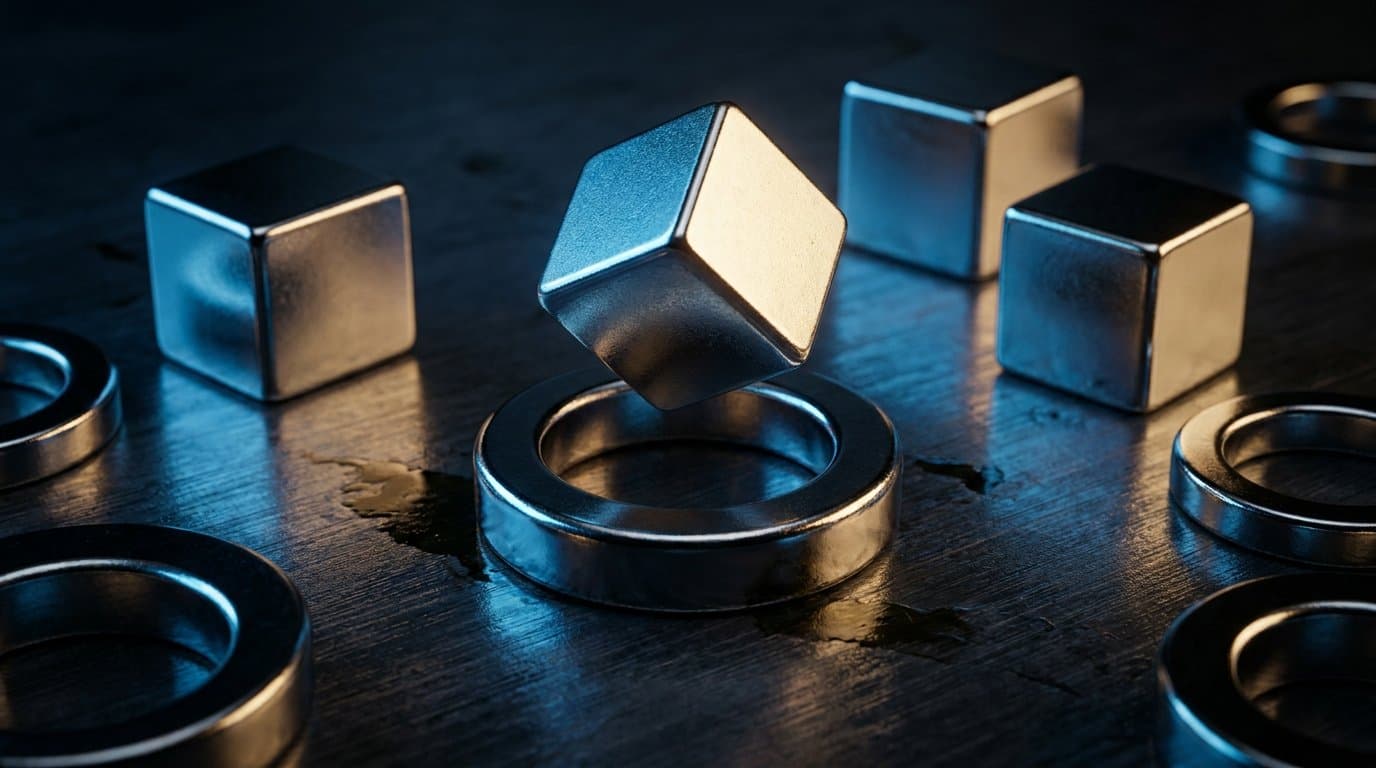
Rare earth magnets are the quiet enablers of the modern economy. They are why your phone buzzes, your EV accelerates, offshore turbines generate without gearboxes and drones hold position in wind. Pound for pound, nothing humanity has manufactured produces more magnetic force - and nothing has created a more strategically concentrated materials dependency.
This guide explains what rare earth magnets actually are, how the two families differ, and why a handful of elements inside them move billion-dollar markets.
What Makes a Magnet "Rare Earth"?
All permanent magnets store magnetic energy in aligned electron spins. Rare earth elements - with their unpaired 4f electrons - produce magnetocrystalline anisotropy orders of magnitude stronger than iron alone: they lock magnetization along a crystal axis so fiercely that the magnet resists demagnetization even in small, hot, hostile environments.
Two families dominate:
- NdFeB (neodymium-iron-boron) - Nd₂Fe₁₄B, discovered in 1983, the strongest commercial magnet ever made
- SmCo (samarium-cobalt) - SmCo₅ / Sm₂Co₁₇, the 1970s predecessor that still owns the extreme-environment niche
A third rare earth system, samarium-iron-nitride (SmFeN), is emerging commercially for smaller motors, but NdFeB defines the market.
NdFeB: The Workhorse
Composition: roughly 29–32% rare earths by weight - mostly neodymium with praseodymium (the NdPr pairing covered in our NdPr guide) - plus iron, boron, and decisive small additions:
- Dysprosium (and/or terbium) - substituted into the crystal to raise coercivity at temperature. A standard NdFeB grade loses strength above ~80°C; EV traction motors run hotter. Adding 1–6% Dy (or grain-boundary-diffused Tb, the modern, thriftier technique) keeps magnets stable to 150–200°C. This is why two obscure heavy rare earths carry national-security weight - see heavy vs light rare earths
- Cobalt, copper, aluminum, gallium - corrosion resistance and microstructure control
Manufacturing is a precision powder-metallurgy chain: vacuum strip casting → hydrogen decrepitation → jet milling to single-crystal-sized powder → pressing in an aligning magnetic field → sintering → machining → coating → magnetization. Every step guards against oxidation; every step embeds know-how that took decades to industrialize - roughly 90% of it currently in China.
Where NdFeB goes:
| Application | Magnet content | Why NdFeB |
|---|---|---|
| EV traction motor | 1–2 kg | Power density = range |
| Offshore wind turbine | ~600 kg/MW | Direct-drive reliability |
| Smartphone | grams | Miniaturized speakers, haptics, cameras |
| Industrial robot | 100s of g per axis | Precision servo torque |
| HDD, appliances, e-bikes, drones | varies | Efficiency in small volumes |
SmCo: The Specialist
Samarium-cobalt trades raw strength (10–20% weaker than NdFeB) for extraordinary robustness:
- Operates to 250–350°C without heavy rare earth additions
- Near-immune to corrosion - no coating required
- Superior radiation tolerance and thermal stability of output
That profile keeps SmCo irreplaceable in aerospace actuators, defense guidance systems, downhole drilling tools, satellites and high-temperature sensors. It also gives samarium - otherwise a modest member of the light rare earth family - a strategic demand base. Cobalt price and supply (DRC-concentrated) is the family's own criticality story.
Ferrites and the Substitution Question
Ceramic ferrite magnets remain ~80% of magnet tonnage - cheap, weak, fine for fridge doors and basic motors. Every rare earth price spike revives the substitution question: can engineers design NdFeB out?
At the margins, yes - some automakers field magnet-free induction or wound-rotor motors, accepting efficiency and packaging penalties. Ferrite-assisted designs stretch weaker materials further. But physics is stubborn: where energy density, mass and volume matter - EVs, aviation, robotics, wind - NdFeB has no peer, and the design-out threat mainly disciplines prices rather than demand.
The Demand Machine
Magnet demand is the engine pulling the entire rare earth complex:
- Permanent magnets consume ~30% of rare earth volume but generate ~80% of market value
- NdFeB demand is forecast to grow 7–9% annually through 2035 (Adamas Intelligence and peers), driven by EVs, wind, robotics and defense
- Each demand story is also a Dy/Tb story: high-temperature applications need the heavies, whose supply is 98–99% Chinese-separated - the market's tightest chokepoint
2025–2026 made the dependency explicit: Chinese export controls on magnets and heavy rare earths disrupted Western automakers and defense programs within weeks, and ex-China magnet-grade material now trades at structural premiums.
From Magnet Back to Mine
Every NdFeB magnet begins as mineral concentrate. Follow the value backward:
- Magnet (highest value) ← 2. NdPr metal ← 3. Separated oxides ← 4. Concentrate - monazite, bastnaesite or mixed REO, where the contained NdPr (and any Dy/Tb/Y credits) sets the price ← 5. Ore
Western magnet and separation plants under construction all face the same question: whose concentrate? That is the layer where independent suppliers operate, and where buyers can act today rather than in 2028 - as our supply chain guide maps in full.
Grades, Coatings and the Practical Magnet Taxonomy
Commercial NdFeB is sold in grades encoding two numbers: maximum energy product and temperature rating. An "N42" delivers 42 MGOe at standard temperature; suffix letters (M, H, SH, UH, EH, AH) mark ascending heat tolerance - from 80°C for unsuffixed grades to 230°C for AH - achieved through heavy rare earth additions and microstructural engineering. This taxonomy is where materials meet money: an EV motor magnet spec of N38UH implies a dysprosium/terbium recipe, which implies heavy rare earth procurement, which implies exposure to the tightest supply chokepoint on earth. Reading magnet grade tables is reading mineral demand.
Coatings complete the picture: NdFeB corrodes enthusiastically, so magnets ship plated - nickel-copper-nickel standard, epoxy, zinc or specialized stacks per environment. SmCo's corrosion immunity, by contrast, is one of the quiet reasons it survives in marine and medical niches despite its energy-product disadvantage.
Frequently Asked Questions About Rare Earth Magnets
How much rare earth is actually in a NdFeB magnet? Roughly 29–32% by weight - predominantly neodymium and praseodymium, with dysprosium/terbium from under 1% (consumer grades) to 6%+ (high-temperature automotive and defense grades), plus minor gadolinium or holmium in some recipes.
Why not just use ferrite magnets and avoid the supply drama? Physics: ferrites deliver roughly a tenth of NdFeB's energy product. Where size and mass barely matter - wall-mounted speakers, basic motors - ferrite wins on cost and does. Where power density decides the product (EV range, turbine nacelle mass, robot joint torque), there is no contest and no substitute.
What is grain boundary diffusion and why does it matter to mineral markets? A manufacturing technique that concentrates dysprosium/terbium at grain boundaries - where coercivity is actually won - rather than alloying it throughout. It cut heavy rare earth loadings per magnet dramatically over the last decade, which is why Dy demand grew slower than magnet output. Thrifting continues, but boundaries have physics limits too.
Are there post-NdFeB magnet technologies on the horizon? Iron nitride, manganese-based compounds and other rare-earth-free candidates progress in laboratories, with commercial whispers perpetually five years out. SmFeN is real and commercializing for smaller motors. Serious forecasts keep NdFeB dominant through 2040 - innovations arrive as complements and thrifts, not replacements.
Where do magnet makers buy their rare earths? As metal/alloy from reduction plants, which buy separated oxides from separators, which buy concentrate from suppliers like us. Every link currently concentrates in China, which is why Western magnet plants under construction are contracting upstream - sometimes all the way to concentrate - before their furnaces even arrive.
Key Takeaways on Rare Earth Magnets
- NdFeB is the strongest magnet commerce has produced - ~30% rare earth by weight, anchored by NdPr with heavy rare earth additions purchasing temperature stability grade by grade (N-suffix taxonomy encoding the recipe).
- Dysprosium and terbium are why heavies matter: high-temperature coercivity for EV motors, turbines and defense has no substitute - grain-boundary diffusion thrifts loadings but cannot eliminate them.
- SmCo owns the extreme niche: weaker but corrosion-immune and stable to 350°C, keeping samarium strategic through aerospace and defense demand.
- Ferrite substitution is a physics question with a settled answer: a tenth the energy product confines it to applications where size and mass don't matter - which excludes every growth market.
- Manufacturing is the deepest moat: the powder-metallurgy chain and its embedded know-how sit ~90% in China; Western plants under construction are contracting materials - sometimes to concentrate level - before commissioning.
- Magnet grades map to mineral demand: reading an N38UH specification is reading a Dy/Tb procurement requirement, which is reading exposure to the market's tightest chokepoint.
- Every magnet starts as concentrate: the NdPr and heavy values in feedstock assays are the same atoms in tomorrow's motor - buy the distribution, not the headline grade.
Feedstock for the Magnet Age
CriticalOre supplies the raw material behind the magnets: rare earth concentrate, monazite and bastnaesite with independently assayed NdPr content - plus documented heavy rare earth values where present - from Southeast Asian origins outside the chokepoints.
Magnet-chain processor or trader? Request a quote with your specification, and receive an assay-backed offer within one business day.