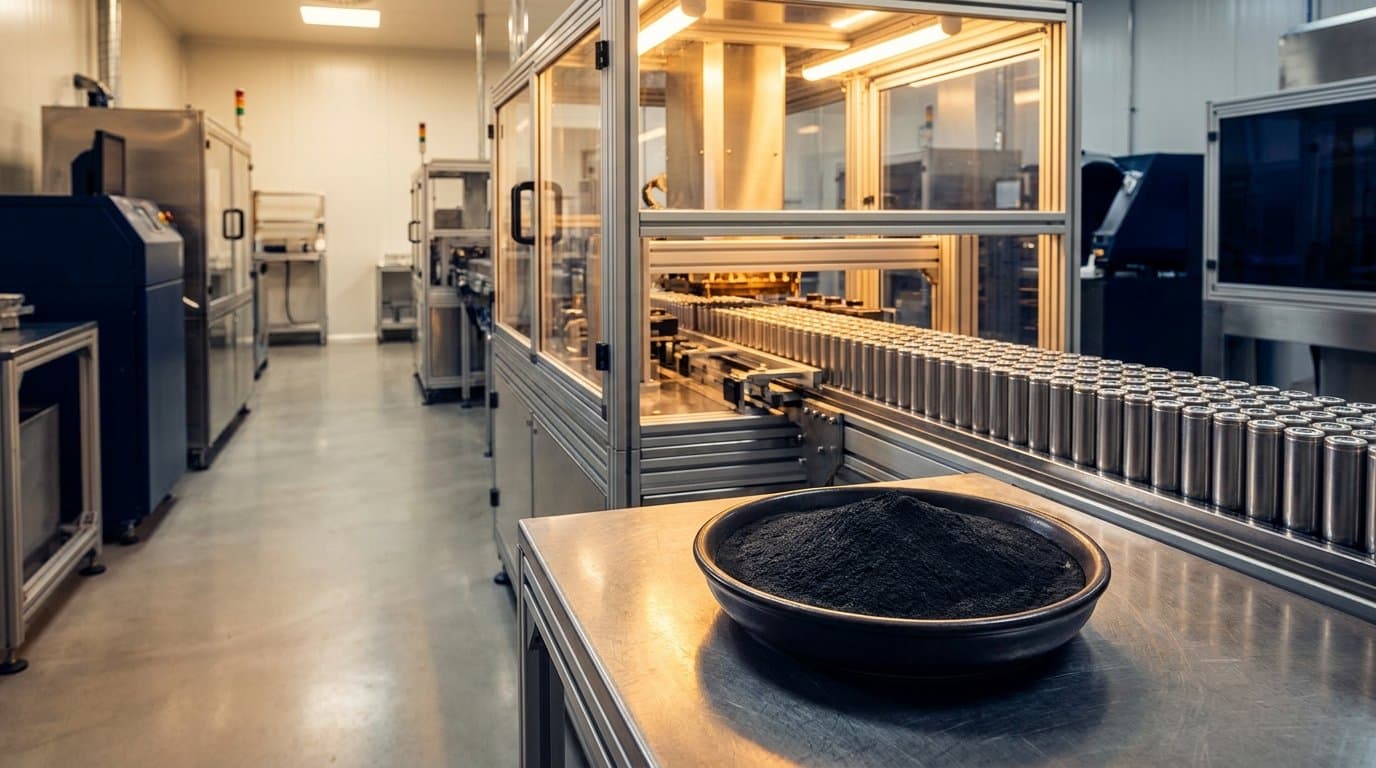
Ask what's inside a lithium-ion battery and most people name lithium, maybe cobalt. Almost nobody names the element that outweighs them all: graphite. At 50–100 kg per EV battery pack, graphite is the single largest material input in every lithium-ion cell - and the anode it forms is a supply chain story every bit as concentrated, and arguably less solved, than the rare earth saga.
Here is the buyer's guide to natural graphite: the grades, the processing chain from flake to anode, and the widening gap between Western battery ambitions and graphite reality.
Graphite 101: One Element, Two Products
Natural graphite is crystalline carbon, mined in two commercially distinct forms:
Flake graphite - well-formed crystalline plates, upgraded by flotation to concentrates of 90–97% fixed carbon, classified by mesh size (large flake +80 mesh commanding premiums; fine -100/-200 mesh feeding battery processing). Flake is the only natural graphite that can become battery anode material, and also serves expandable graphite, high-end refractories and foils.
Amorphous graphite - microcrystalline material at 75–85% fixed carbon, the economical workhorse for steelmaking recarburization, foundry facings, brake linings and lubricants. No battery role, but steady industrial demand.
(Synthetic graphite - manufactured from petroleum needle coke at 3,000°C - competes in anodes with different economics and a heavy energy/CO₂ footprint; most cells blend natural and synthetic.)
Our graphite product page covers both natural forms and their specifications.
From Flake to Anode: The Value Ladder
The journey from mine to cell multiplies value roughly tenfold - and concentration risk with it:
- Mining & flotation → flake concentrate (90–97% C) - diversified: China, Mozambique, Madagascar, Brazil, Tanzania, with Southeast Asian production serving regional industry
- Micronization & spheroidization → milled flake shaped into potato-like spheres (packing density is everything in an anode); yields run ~50%, with the byproduct fines sold downstream
- Purification → 99.95%+ C via hydrofluoric-acid or thermal routes - environmentally demanding, historically almost entirely Chinese
- Coating & finishing → carbon-coated spherical graphite (CSPG), the finished anode-active material, qualified cell-by-cell with each battery maker
China performs ~78% of the world's natural graphite mining and near-100% of spheroidization/purification. When Beijing added graphite anode materials to its export-license regime (from late 2023, with periodic tightenings since), the battery industry received the same lesson the magnet industry got - see the pattern in our China dominance analysis.
The Demand Wave
Battery demand for graphite is compounding relentlessly:
- Each EV carries 50–100 kg of graphite (anode mass ≈ 1.2× the cathode)
- Stationary storage adds grid-scale packs with the same chemistry
- Forecasts consistently show battery demand tripling by 2030, pushing graphite from ~4M tpa toward 8–10M tpa across natural and synthetic
Yes, silicon anodes are coming - as blends (5–10% silicon boosting energy density) that still ride on graphite backbones. Solid-state designs with lithium-metal anodes remain end-of-decade stories at scale. For any planning horizon that matters commercially, graphite is the anode.
The Western Supply Gap
The EU lists natural graphite among its CRMA strategic materials (the CRMA explained); the US, UK, Japan and Australia all classify it as critical. The gap the policies address:
- Europe's gigafactory pipeline implies hundreds of thousands of tonnes of annual anode demand - against near-zero domestic natural graphite production and no operating spheroidization at scale
- New mines (Mozambique, Madagascar, Tanzania, Canada, Scandinavia) are advancing, but the midstream - spheroidization and purification - is the chokepoint being rebuilt from scratch
- IRA/CRMA-era localization rules increasingly require ex-China anode content for subsidy eligibility, creating a compliance-driven premium market mirroring the rare earth pattern
The result: battery makers and their suppliers are signing long-dated offtakes for flake concentrate years ahead of their processing capacity - locking feedstock first, building midstream second.
Buying Natural Graphite: What Matters
Specification discipline separates professionals from tourists in the graphite market:
- Fixed carbon - verified per lot by an accredited lab, with LOI/ash breakdown (testing methods apply here too)
- Mesh distribution - sieve analysis against your application: large flake for expandables/refractories, fine flake for battery processing feed, amorphous for metallurgy
- Impurity profile - sulfur, iron, silica; battery-track material has ppm-level ceilings downstream
- Moisture - <0.5% standard; graphite's stability makes it forgiving cargo, but settlement is on dry weight
- Packaging - 25 kg bags palletized or 1 MT jumbo bags with liners (shipping guide)
- Documentation - COA, origin and chain of custody; anode-track buyers inherit battery-passport style documentation demands (EU Battery Regulation) that reach back to the mine
Specification Deep-Dive: What Battery-Track Buyers Test
Anode-chain purchasers evaluate flake concentrate against parameters casual graphite buyers never encounter. Tap density and morphology determine spheroidization yield - the economics of the entire midstream step hinge on how much of your flake survives shaping. Crystallinity (measured by XRD d-spacing) correlates with achievable capacity; well-ordered natural flake approaches graphite's theoretical 372 mAh/g in finished anodes. Trace metals - iron above ~50 ppm, plus copper, chromium and nickel - threaten cell safety through dissolution and dendrite mechanisms, so battery-track material faces ppm ceilings that refractory-grade never meets. And consistency across lots matters more than any single result: cell qualification locks a material's specification window, and drift outside it triggers requalification costs that dwarf any price advantage.
The practical sequence for aspiring battery-chain suppliers mirrors what buyers should demand: characterize thoroughly, sample generously, expect 12–24 month qualification timelines with cell-maker end customers, and treat every specification parameter as a contract term. Material that "meets 95% carbon" is a commodity; material that holds a battery specification window lot after lot is a strategic supply relationship.
Frequently Asked Questions About Natural Graphite
What is the difference between battery-grade and regular flake graphite? Battery-track flake meets tighter trace-metal ceilings, suitable morphology for spheroidization and consistent crystallinity - then becomes "battery-grade" only after purification to 99.95%+ and coating. Concentrate itself is never battery-grade; it is battery-track feedstock, priced on its suitability for that chain.
Why does mesh size matter so much in graphite pricing? Large flake (+80 mesh) earns premiums for expandable graphite and specialty applications; medium and fine flake feeds battery processing and refractories at standard pricing; amorphous serves metallurgy at economy pricing. The same deposit can produce multiple price tiers - sieve analysis is where graphite value is discovered.
How exposed is graphite to synthetic substitution? Anode chemistry blends both: synthetic offers cycle-life advantages, natural offers cost and footprint advantages, and most cells use engineered mixtures. Synthetic capacity (petroleum-coke based, energy-intensive) has grown aggressively in China - but IRA/CRMA-era localization math and CO₂ accounting keep natural flake structurally necessary in Western chains.
What did China's export controls change for graphite buyers? Since late 2023, spherical and high-purity graphite exports require licenses - flow continues but with approval risk, documentation burden and periodic tightening episodes. The effect mirrors rare earths: Western buyers now pay diversification premiums and contract ex-China flake years ahead of midstream capacity.
Does CriticalOre supply battery-track material? We supply flake concentrate (90–97% C) with the sieve analysis and impurity documentation battery-chain processors require for evaluation, plus amorphous grades for industrial applications. Buyers with spheroidization capacity or tolling arrangements treat our flake as feedstock; refractory and metallurgical buyers purchase to their own specifications.
Key Takeaways for Graphite Buyers
- Graphite is the battery's biggest ingredient: 50–100 kg per EV pack - larger than any cathode metal - making anode demand the growth engine that triples the market by 2030 on standard forecasts.
- Only flake feeds batteries: 90–97% C flake concentrate is battery-track feedstock; amorphous (75–85% C) serves steel and industry - the two products share an element and nothing else commercially.
- The midstream is the chokepoint: China's ~78% mining share understates its near-100% grip on spheroidization and purification; export licensing since 2023 made that grip operational.
- Mesh is money: large flake premiums, fine-flake battery feed and amorphous economy grades can emerge from one deposit - sieve analysis is where graphite value is actually discovered.
- Battery-track specs are a different sport: tap density, crystallinity and ppm-level trace metal ceilings - plus 12–24 month qualification cycles - separate strategic supply relationships from commodity parcels.
- Localization rules drive premiums: IRA and CRMA-era content requirements make documented ex-China flake a compliance asset contracted years ahead of Western midstream capacity.
- Silicon supplements, doesn't replace: anode blends ride graphite backbones through every realistic planning horizon - the substitution headline to ignore until cell chemistry actually changes.
A last word on positioning: the graphite market's peculiar feature is that its midstream bottleneck is buildable - spheroidization plants take three years, not fifteen - meaning today's feedstock relationships convert into tomorrow's integrated positions faster than in any other battery material. Flake secured now is optionality on that conversion.
Feedstock First
Every anode strategy on earth reduces to the same first step: secure verified flake graphite from origins you can document. CriticalOre supplies natural flake and amorphous graphite - 90–97% and 75–85% fixed carbon respectively - with sieve analysis, full COA and export documentation from Southeast Asian and partner origins.
Whether you feed refractories today or a battery supply chain tomorrow, request a quote and put a real specification on the table.