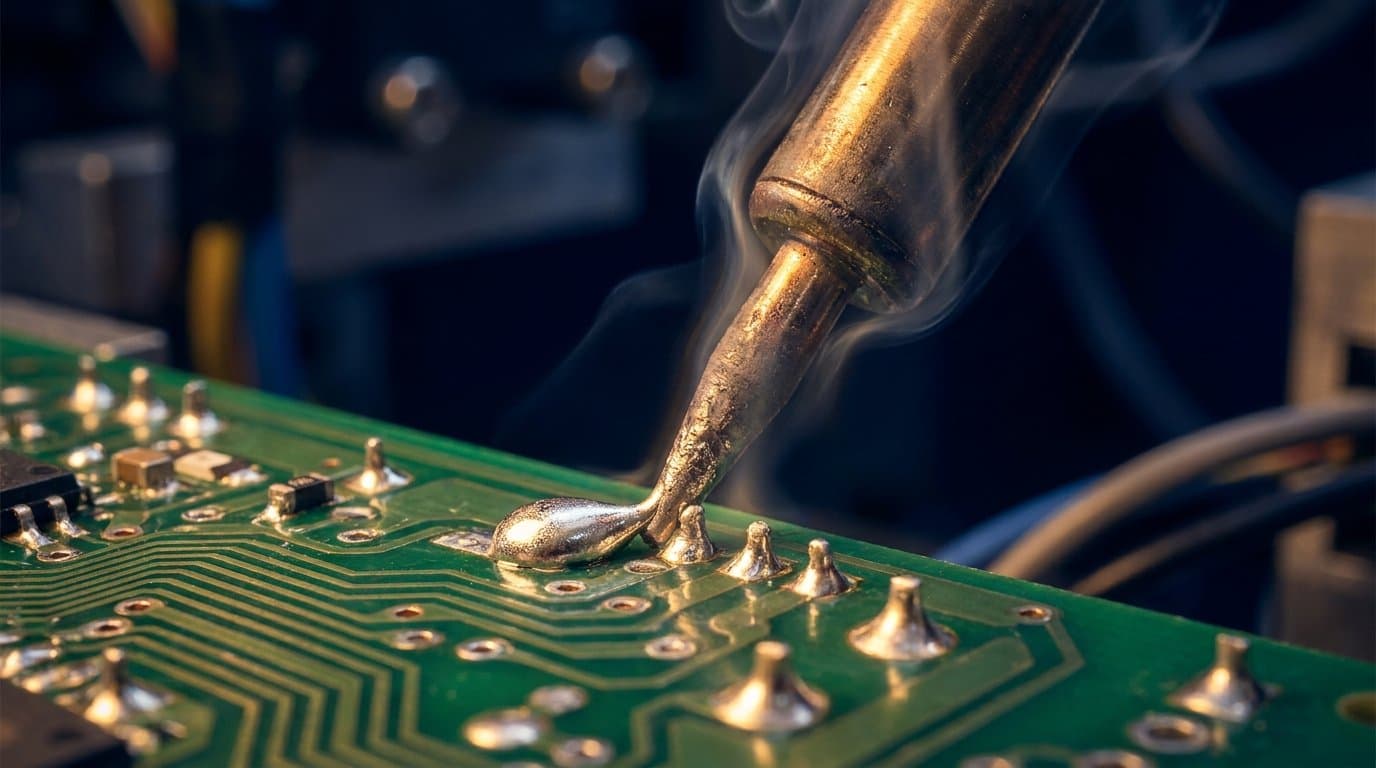
Every electronic device on earth is held together - literally - by tin. The joints connecting chips to boards, boards to connectors, connectors to the world: solder, and solder is mostly tin. That single fact makes element 50 a critical mineral in every major economy, gives it the most direct AI-boom exposure of any base metal, and keeps its ancient Southeast Asian supply belt strategically relevant three thousand years after the Bronze Age made it famous.
Here is the modern tin story, from cassiterite concentrate to the solder paste inside the data center buildout.
Where Tin Demand Lives
- Solder (~50%). Since lead-free regulation (RoHS) remade electronics manufacturing, solder alloys run 96%+ tin. Every smartphone, server, vehicle ECU and inverter carries tin joints by the thousands. Electronics production is tin demand - and the AI datacenter cycle, power electronics and EV content growth all feed it
- Chemicals (~17%). PVC stabilizers, catalysts, glass coatings
- Tinplate (~12%). The original "tin can" - steel food packaging with corrosion-proof tin coating
- Lead-acid batteries & alloys (~15%). Grid alloys, bearing bronzes, pewter and specialty metallurgy
- Emerging: tin's role in advanced semiconductor packaging (solder bumps at ever-finer pitch) and potential battery chemistries keeps the demand story technology-linked
The International Tin Association's long-standing observation holds: tin is the glue of electrification. MIT once ranked it the metal most likely to benefit from new technologies - a forecast the 2020s keep validating.
Supply: The Old Belt and Its New Politics
Tin production is a story of concentration with familiar risk notes:
- China (~30%) - largest producer and dominant refiner, with domestic mines depleting
- Indonesia (~20%) - the great exporter, whose periodic export-policy shifts (refined-only mandates, licensing pauses) move world prices repeatedly
- Myanmar (~10–15%) - the Wa State mines that surged in the 2010s now swing global supply with every suspension; the 2023–2025 stoppages helped drive tin's price spikes
- Peru, Bolivia, Brazil, DR Congo, Nigeria - the balance, each with its own stability discount
- Thailand and Malaysia - the historic heart of the trade, today hosting smelting (MSC in Malaysia, Thaisarco in Thailand among the region's institutions), secondary production and tin-tailings recovery feeding regional concentrate flows
Add tin's status as a 3TG conflict mineral - with OECD/RMI due-diligence expectations on any Western-facing supply chain - and provenance documentation is not optional paperwork; it is market access (responsible sourcing guide).
Cassiterite Concentrate: The Traded Product
Tin enters world trade primarily as cassiterite (SnO₂) concentrate, graded on tin content:
| Specification | Typical Range |
|---|---|
| Sn content | 60–74% (premium >70%) |
| Iron (Fe) | <3% |
| Arsenic (As) | <0.3% |
| Sulfur (S) | <0.5% |
| Tungsten (WO₃) | reported - a credit in tin-tungsten belt material |
| Moisture | <2% |
Pricing references the LME tin contract - tin is the rare critical mineral with a deep exchange benchmark - with concentrate settling at a percentage of LME less treatment charges, adjusted for grade and penalties. The payable logic mirrors rare earth basket pricing, with the luxury of a transparent reference price.
Buyer diligence follows the standard playbook - independent assay, sealed umpire samples, full COA scrutiny - plus tin's specifics: radiological screening where tailings-derived material may carry monazite association, and airtight chain-of-custody for 3TG compliance.
Why the Tin-Tungsten-Tantalum Belt Matters Twice
Southeast Asia's granite belts host tin alongside tungsten, tantalum and rare-earth-bearing minerals - historical tin tailings are among the region's meaningful monazite and xenotime sources. For a supplier like CriticalOre, that geology makes tin concentrate, tungsten concentrate and monazite natural portfolio companions from shared origins and logistics - and for buyers, it makes the region a one-stop diversification play (Southeast Asia hub guide).
The Market Setup
Tin's structural position entering the late 2020s:
- Demand: electronics recovery plus AI/datacenter capex plus EV/renewables content growth - steady compounding with technology optionality
- Supply: aging mines, Myanmar volatility, Indonesian policy risk, a thin project pipeline - and refined capacity concentrated in Asia
- Inventories: chronically thin by historical standards, amplifying every disruption
- Verdict: most analysts project persistent deficits punctuated by policy-driven spikes - a market that rewards secured, documented supply relationships over spot opportunism
Reading the Tin Market: Three Signals That Matter
Professional tin watchers track a short list of leading indicators. LME inventories and spreads come first: tin's exchange stocks are chronically thin - a few thousand tonnes against ~380,000 tonnes of annual demand - so backwardation (spot above futures) reliably signals physical tightness before headlines do. Myanmar's Wa State production comes second: the region's mines swing more supply than any other single variable, and every suspension announcement since 2023 has moved prices double digits within weeks. Semiconductor billings come third: because half of tin is solder, global chip-sector revenue is a demand proxy with a one-to-two quarter lead on tin consumption - the AI datacenter cycle showing up in element 50's order books.
For concentrate sellers and buyers alike, these signals shape timing: contracting term supply during quiet periods beats scrambling in a Myanmar-driven spike, and formula pricing against LME smooths what timing cannot avoid.
Frequently Asked Questions About Tin Concentrate
What grade is considered good cassiterite concentrate? Premium concentrate runs above 70% Sn; 60–70% is standard tradable material; below 60% trades at wider discounts and higher unit treatment costs. Iron, arsenic and sulfur caps matter as much as the headline - smelters penalize hard above thresholds.
How is tin concentrate priced? Against the LME tin contract: payable metal (typically 96–98.5% of contained tin depending on grade) at the LME average over an agreed quotation period, minus a negotiated treatment charge. Tin is the rare critical mineral with a deep, transparent exchange benchmark - use it.
Does tin concentrate carry radioactivity concerns? Sometimes. Cassiterite from granite-belt and tailings sources can associate with monazite and other thorium-bearing heavy minerals. Professional lots ship with radiological screening documentation; ours always do, and material exceeding thresholds is handled under NORM procedures.
What makes tin a "critical mineral" if it trades on the LME? Criticality reflects supply concentration and irreplaceability, not price opacity. Solder has no practical substitute in electronics assembly, three countries dominate mining, and China leads refining - the EU, US, UK and Japan all list tin accordingly.
What are the 3TG obligations for tin buyers? Tin is the first "T" in 3TG. Western-facing supply chains require OECD-aligned due diligence: documented chain of custody, RMI-conformant smelters, and CMRT reporting. Build these requirements into contracts - retrofitting provenance after purchase is impossible.
Can you supply tin concentrate with tungsten credits? Southeast Asian tin-tungsten belt material frequently carries recoverable WO₃, which we assay and itemize per lot. Depending on your smelter's flowsheet, tungsten content trades as a credit rather than an impurity - one more reason full element distribution beats summary grades.
Key Takeaways for Tin Buyers
- Solder is destiny. Roughly half of global tin becomes electronic solder, making semiconductor and electronics production cycles the demand signal to watch - including the AI datacenter buildout now flowing through to element 50's order books.
- Cassiterite concentrate at 60–74% Sn is the traded product, priced against LME tin with payables of 96–98.5% and treatment charges negotiated per parcel - the rare critical mineral with a transparent exchange benchmark behind it.
- Penalty discipline pays. Iron, arsenic and sulfur caps move settlement value as much as headline grade; full independent assay per lot is the professional baseline, not an option.
- Provenance is market access. As a 3TG conflict mineral, tin entering Western supply chains requires OECD-aligned chain-of-custody and RMI-conformant smelting - undocumented units are unsaleable into the best-paying channels.
- Supply risk is geographically specific. Myanmar's Wa State swings, Indonesian export policy and thin LME inventories are the three recurring disruptors; term contracts with documented Southeast Asian origins hedge all three.
- Watch tungsten credits. Tin-tungsten belt material often carries recoverable WO₃ - itemized assay converts an "impurity" into invoice value with the right smelter.
- Radiological screening is standard practice for tailings-derived cassiterite given monazite association; documented low-activity results keep containers moving through cautious ports.
A final note on timing: tin's demand signals (semiconductor billings, electronics PMIs) publish months before concentrate negotiations feel them, giving attentive buyers a genuine information edge - one of the few critical mineral markets where public data leads private pricing so reliably.
And a structural footnote worth filing: unlike most critical minerals, tin has no meaningful Western revival pipeline - no subsidized mega-mines, no price floors, no strategic buildout. Supply security in tin is achieved almost entirely through relationships with existing producing regions, which concentrates the value of documented Southeast Asian supply channels even further.
Tin, From the Source
CriticalOre supplies cassiterite concentrate at 60–74% Sn from vetted Southeast Asian origins: independent assay with penalty and credit elements itemized, RMI-aligned chain-of-custody documentation, and export through Thai ports under FOB, CIF or DAP terms to smelters and traders worldwide.
Solder-chain buyer or trading desk, request a quote with your specification - firm offers within one business day.