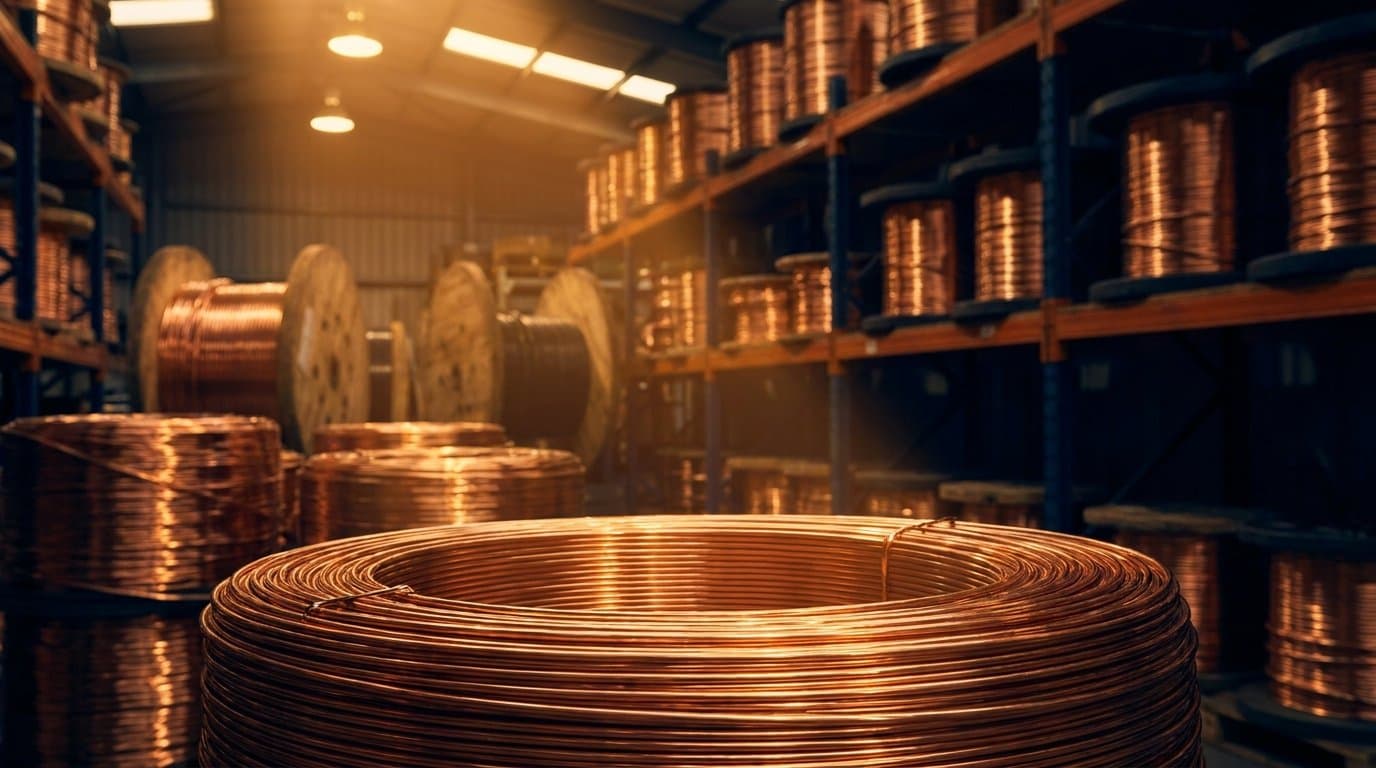
Copper needed no rebranding for five thousand years - and then the energy transition made the world's most familiar industrial metal "critical" almost overnight. The EU added it to the CRMA strategic list; the US followed with its own designations; and every electrification forecast collides with the same arithmetic: you cannot decarbonize without conductors, and copper is the conductor.
Here is copper's modern story, told for people who buy, sell or think about the concentrate that feeds it.
The Demand Machine: Everything Electric Is Copper
Copper intensity is the energy transition's common denominator:
| Application | Copper content |
|---|---|
| Conventional car | ~20–25 kg |
| Battery EV | ~60–80 kg (motor windings, busbars, harnesses, charging) |
| Onshore wind | ~3–5 t/MW |
| Offshore wind | ~8–10 t/MW (export cables dominate) |
| Solar PV | ~4–5 t/MW |
| Data centers | tens of tonnes per facility - the AI buildout's quiet copper bid |
Add grid expansion - the transmission and distribution buildout that every net-zero and energy-security plan requires, and which consumes more copper than the generation it connects - and credible forecasts (S&P Global, IEA, major houses) converge on demand rising from ~25–26 Mt today toward 35–40 Mt by 2035, with cumulative supply gaps measured in multiple Mt unless investment accelerates dramatically.
Substitution (aluminum in some cable classes) trims the edges; it does not change the shape.
Supply: The Hard Half of the Story
Copper's problem is not geology - it is time and grade:
- Declining grades - the average mined grade has fallen for decades; more rock moved per tonne of metal means capex and cost inflation baked in
- Development timelines - a new copper mine averages 15+ years from discovery to production; the 2030s supply is, for practical purposes, already decided
- Concentration where it counts - Chile and Peru dominate mining (with recurring political/operational risk); the DRC's rise adds its own profile; and China smelts/refines roughly half the world's copper, making the midstream the familiar chokepoint
- The 2025–2026 smelter signal - treatment and refining charges (TC/RCs) collapsed to historic, even negative, levels as smelting capacity outran concentrate supply: smelters effectively paying for feed. Nothing announces a concentrate seller's market louder
How Copper Concentrate Trades
Copper concentrate is the great teacher of concentrate commerce - the template other minerals borrow (rare earth pricing included):
- Product: flotation concentrate, typically 20–30% Cu (ours runs 18–28%), with gold and silver by-product credits often material to economics
- Pricing: LME copper price for payable metal (standard payables ~96.5–97% Cu subject to deductions), minus TC/RC (treatment charge per dry tonne, refining charge per pound) - the negotiated smelter margin that annual benchmark talks set and spot markets stress-test
- Credits and penalties: Au/Ag paid above thresholds; arsenic, lead, zinc, bismuth, fluorine penalized above caps - assay detail is invoice detail
- Settlement mechanics: surveyor-supervised weighing/sampling/moisture at load and discharge, split assays with umpire provisions (the COA discipline), provisional-to-final pricing against quotation periods
Safety layer: copper concentrate is a Group A cargo under the IMSBC Code - liquefaction risk - so certified TML/moisture documentation is not paperwork pedantry; it is what lets the cargo sail (shipping guide).
Copper's "Critical" Status: What It Changes
Being listed alongside rare earths in the CRMA (guide) and US frameworks shifts copper procurement in recognizable ways:
- Permitting acceleration for strategic projects (slowly, but visibly - South32's Hermosa fast-track being an early US example)
- Origin documentation expectations migrating from conflict-minerals practice into mainstream copper buying
- Strategic stockpile conversations - historically unthinkable for a 25-Mt market, now genuinely discussed for defense-relevant forms
- Smelter diversification funding - the West rediscovering that mine supply without midstream capacity recreates the same dependency in a different metal
What Buyers Should Do Differently Now
- Treat concentrate access as strategic - in a negative-TC world, feed is the scarce asset; term relationships beat spot hunting
- Assay everything, credit everything - Au/Ag credits and penalty exposure swing economics more than headline Cu grade; demand full-element independent assay
- Respect the IMSBC layer - moisture/TML discipline at origin is non-negotiable; audit your supplier's practice before the first booking
- Document provenance - critical-mineral copper is converging on chain-of-custody norms; suppliers who provide it standard (as we do) future-proof your compliance file
The Concentrate Squeeze: What Negative TCs Are Telling Us
The 2025–2026 collapse of treatment charges into negative territory deserves a closer look, because it rewrites assumptions that held for a generation. Smelting capacity - expanded aggressively in China, Indonesia and India - now exceeds concentrate supply so decisively that smelters compete for feed by paying miners above the metal price rather than charging for conversion. For integrated majors this is an accounting curiosity; for custom smelters it is an existential margin crisis; and for anyone holding independent concentrate, it is pricing power unseen in decades.
History suggests the imbalance persists: new smelters are committed and building, while the mine projects that would feed them remain stuck in the 15-year development pipeline. Every credible analyst projects concentrate deficits deepening through the late 2020s. The strategic conclusion for buyers extends beyond copper - this is the clearest demonstration in any metal of why feedstock relationships, not processing capacity, are the scarce asset of the electrification era. The same dynamic, a few years less mature, is unfolding across rare earths, graphite and every mineral this blog covers.
Frequently Asked Questions About Copper Concentrate
What do TC/RC actually mean on my invoice? Treatment charge (dollars per dry metric tonne of concentrate) and refining charge (cents per pound of payable copper) are the smelter's conversion fees, deducted from the LME value of payable metal. Annual benchmark settlements between major miners and Chinese smelters set the reference; spot terms fluctuate around it - lately, below zero.
What payables are standard for copper concentrate? Typically ~96.5–97% of contained copper (with a minimum deduction of ~1 unit), gold payable above ~1 g/t and silver above ~30 g/t at 90%+ rates per negotiation. Penalty elements - arsenic above ~0.2%, plus lead, zinc, bismuth, fluorine - deduct per contract schedule.
Why is moisture such a big deal in copper concentrate shipping? Two reasons: you pay for dry tonnes, and - more seriously - copper concentrate is a Group A liquefaction-risk cargo under the IMSBC Code. Cargo shipped above its certified Transportable Moisture Limit can liquefy at sea and capsize vessels; certified TML documentation is legally mandatory and non-negotiable.
Is copper really "critical" like rare earths? Different criticality profile: copper's risk is volumetric (multi-Mt deficits ahead) rather than concentration-driven at the mine level - though Chinese smelting dominance adds a familiar midstream angle. The EU's CRMA strategic listing and US designations reflect electrification's absolute dependence on the metal.
How do by-product credits change concentrate economics? Materially. A concentrate carrying 2 g/t gold and 60 g/t silver can earn credits worth a meaningful fraction of its copper value. Always demand full precious-metals assay - concentrate priced on copper alone may be leaving your money on the seller's table.
Key Takeaways for Copper Concentrate Buyers
- Electrification is copper arithmetic: EVs at 60–80 kg, offshore wind at 8–10 t/MW, data centers by the tens of tonnes - demand heads from ~26 Mt toward 35–40 Mt by 2035 against a mine pipeline that takes fifteen years to answer.
- Negative TC/RCs rewrote the power map: smelters paying for feed means concentrate holders - not processors - currently own the scarce asset; term feedstock relationships are the strategic position.
- Payables and credits decide economics: ~96.5–97% Cu payables, gold and silver credits above thresholds, and penalty schedules for As/Pb/Zn/Bi/F move more money than headline grade - demand the full assay.
- IMSBC compliance is existential, not clerical: Group A liquefaction rules make certified TML/moisture documentation the difference between a shipped cargo and a stranded one.
- "Critical" status is operational: CRMA listing, US designations and origin-documentation expectations are migrating conflict-minerals discipline into mainstream copper procurement.
- Grade decline is the quiet driver - structurally lower ore grades bake cost inflation into every forecast, underwriting the deficit thesis independent of demand scenarios.
- The cross-mineral lesson: copper demonstrates most visibly what rare earths, graphite and tin all echo - midstream capacity without feedstock security recreates dependency; buyers who lock documented supply early hold the leverage.
The closing arithmetic worth remembering: every credible net-zero pathway requires bringing on the equivalent of several of the world's largest copper mines each year through 2035 - a buildout rate the industry has never approached. Whether that gap closes through price-driven investment, substitution at the margins or delayed electrification, concentrate holders sit on the right side of the equation.
Copper From CriticalOre
We supply copper concentrate at 18–28% Cu with by-product credits documented, penalty elements screened, certified moisture/TML per the IMSBC Code and full export documentation from Southeast Asian origins - under FOB, CIF or DAP terms.
The metal of electrification rewards buyers who secure it early: request a quote and receive a documented offer within one business day.